

Imagine a client choosing their next spa day based entirely on a five-second scan of search results. Right now, a stressed-out local is searching for relaxation, and whichever Canadian SPA business ranks at the top wins their trust and secures their booking.
As marketing expert Seth Godin famously noted,
“People do not buy goods and services. They buy relations, stories, and magic.”
When your website is buried on page two, potential clients never get the chance to experience that magic. They end up choosing nearby competitors long before ever learning about your tranquil sanctuary, soothing atmosphere, or signature treatment menu.
That disconnect leaves your schedule open, directly costing you revenue and missed opportunities to build long-term loyalty. A breathtaking facility and premium experience mean nothing if search algorithms keep you hidden, because unseen quality cannot keep treatment rooms full.
A strong Spa SEO strategy bridges that gap by putting your brand directly in front of local searchers who are ready to book. That is where Potens Digital helps Canadian spas dominate local search rankings, turn online demand into high-value leads, and consistently fill their calendars year-round.
| From Google Searches to More Spa Bookings! Guests search, shortlist three spas, and book one. They rarely browse. Your Google Business Profile and Google Maps listing usually decide the shortlist. Your website decides whether a shortlisted guest books. Spa packages and a spa membership turn one-time visits into steady revenue. Track bookings and revenue, not just rankings. Spa SEO builds over time. Start early and stay consistent. |
What Is Spa SEO? The Six Essentials Every Spa Owner Should Know
When potential clients search Google for a massage, facial, or luxury spa experience, your visibility can determine whether they book with you or a competitor in Canada.
Search engine optimization (SEO) improves your spa’s visibility on Google by making your treatments, location, and website easier for search engines to understand, connecting your business with people actively searching for spa services.
As Canada’s best SEO agency, Potens Digital helps businesses strengthen their search visibility and turn online searches into client enquiries and bookings. For spa businesses, an effective SEO strategy means reaching potential clients, building trust before their first visit, and encouraging more appointments.
A successful spa SEO strategy combines six essential areas, each playing a distinct role in improving search visibility, building client trust, and generating more bookings:
| SEO Focus Area | What It Includes | How It Helps Your Spa |
| Keyword research | Identifying the terms people use to search for spa treatments | Targets searches relevant to your services and location |
| Local SEO | Google Business Profile, Google Maps, reviews, and local listings | Helps nearby clients find your spa when searching for treatments |
| On-page SEO | Page titles, headings, treatment descriptions, images, and internal links | Clarifies what each page offers to Google and potential clients |
| Technical SEO | Website speed, mobile usability, crawling, indexing, and structured data | Makes your website easier to access and understand |
| Off-page SEO | Quality backlinks, business citations, partnerships, and brand mentions | Strengthens your website’s credibility and authority |
| Content strategy and marketing | Helpful articles, treatment guides, and seasonal promotions | Reaches potential clients researching treatments and wellness options |
**Local SEO is essential for attracting nearby clients, improving your visibility on Google Maps, and turning local searches into spa bookings.
Potential clients often search for nearby treatments, so visibility for terms like “facial spa in Toronto” or “massage near me” is essential for attracting local bookings.
Spa SEO also strengthens your wider marketing strategy. Paid ads generate visibility, social media showcases your treatments, and referrals build trust. SEO captures demand by connecting your spa with people actively searching for your services.
Focus on optimizing your Google Business Profile, improving treatment pages, keeping your website mobile-friendly, and publishing relevant content. Track enquiries and confirmed bookings to measure SEO’s contribution to business growth.
Turn Spa Searches Into Bookings With Smarter Keywords
Potential clients search Google for specific treatments, from “deep tissue massage in Toronto” to “luxury spa packages near me.” These searches reveal what people want and where they want it. Keyword research helps your spa target relevant searches and connect potential clients with the treatments they’re looking for.
According to BrightLocal’s research, 84% of consumers searched online for a local business in the past three months, underscoring the importance of targeting relevant local keywords so potential clients can find your spa. This highlights the importance of understanding how people search for local businesses and using relevant keywords to improve your spa’s online visibility.
Spa-related searches generally fall into four categories, and each requires content that answers a different need:
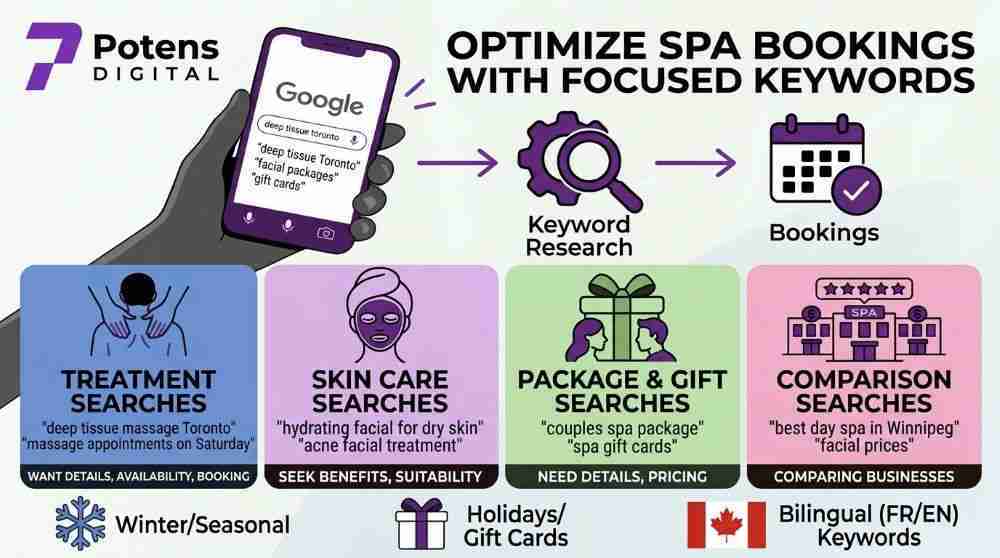
- Treatment searches: “Massage spa near me,” “deep tissue massage in Toronto,” or “massage appointments on Saturday.” These searchers want treatment details, availability, therapist qualifications, and clear booking information.
- Skin care searches: “Hydrating facial for dry skin,” “acne facial treatment,” or “anti-ageing facial.” These clients want clear treatment descriptions, potential benefits, and suitability information.
- Package and gift searches: “Couples spa package,” “bridal spa package,” or “spa gift cards.” These searches require dedicated package pages with pricing and booking details.
- Comparison searches: “Best day spa in Winnipeg,” “facial prices in Toronto,” or “spa near me with good reviews.” These searchers compare businesses and need clear reasons to choose you.
| Canadian spas should also consider local and seasonal trends. Winter can increase interest in hydrating facials and relaxation treatments, while holidays create opportunities to promote gift cards and spa packages. In bilingual markets, French-language keywords can also help reach potential clients. |
How to Find the Best Keywords for Your Spa
- List your treatments. Include massage services, facials, body treatments, skincare services, and signature experiences.
- Add your location. Combine treatment names with the cities and neighbourhoods you serve, such as “deep tissue massage in Halifax.”
- Review client questions. Record common questions from phone calls, social media messages, and reception enquiries.
- Check search demand. Use Google Autocomplete, related searches, and Google Keyword Planner to find keyword ideas and estimated search volumes.
- Choose the right page. Use service pages for treatment searches, package pages for gift and occasion searches, and blog articles to answer common questions.
- Give each page a clear focus. Assign a main keyword topic to each page to avoid unnecessary overlap.
Focus on specific searches such as “prenatal massage near downtown Halifax” or “facial for sensitive skin in Vancouver.” These phrases may receive fewer searches than the broad term “spa,” but they reveal more about what a potential client wants.
Prioritize keywords based on their relevance to your services, local demand, competition, and potential to generate bookings.
| What a Potential Client Searches | The Page to Create |
| “Day spa Calgary” | Homepage or Calgary location page |
| “Deep tissue massage Calgary” | Massage service page |
| “Couples spa package” | Spa packages page |
| “Monthly spa membership” | Spa membership page |
| “How much does a facial cost?” | Pricing page or detailed article |
Review the spa websites that rank for your target keywords and identify gaps in their treatment descriptions, pricing, packages, and booking information. Use these gaps to create more helpful pages that answer client questions, highlight your services, and encourage more bookings.
Local SEO for Spas: Win Google Maps and Your Local Searches
When someone searches for a spa nearby, Google usually shows a map with three listings above any website. This is the local pack, and for many spas it decides who gets the call. Google says local results depend mainly on relevance, distance, and prominence, and you can’t pay for a better local ranking. Anyone who claims otherwise is selling you something.
Set Up a Google Business Profile That Works Like a Storefront
Treat your Google Business Profile as a second website. For many guests, it’s the first one they see.
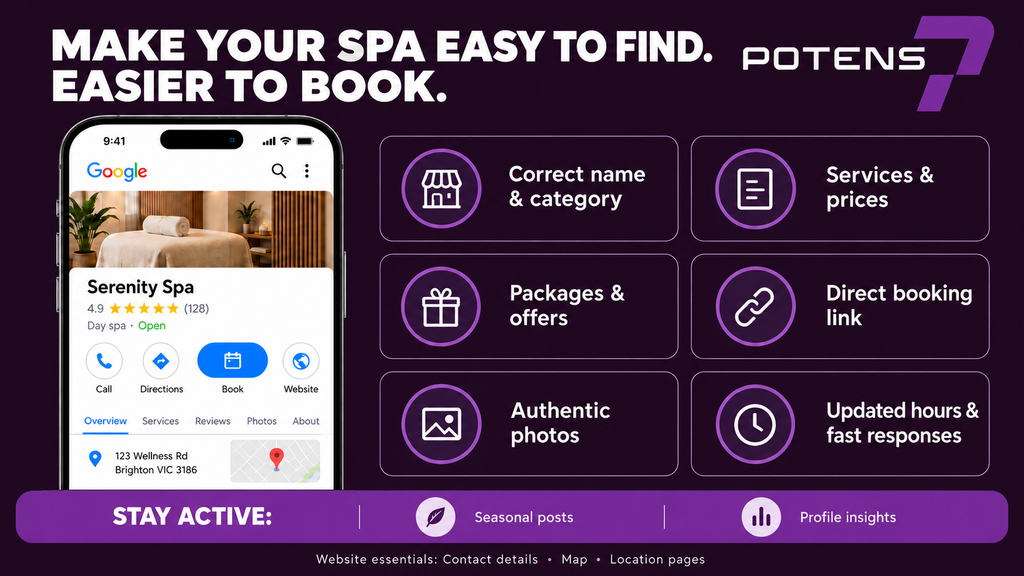
A strong GBP for Spa businesses in Canada includes:
- Your real business name. Adding keywords to the name breaks Google’s rules and can get your profile suspended.
- The right primary category. “Day spa” and “Facial spa” are different choices. Pick the one tied to your biggest revenue.
- Every service, described. List each spa service with a plain description and a starting price where possible.
- Packages and offers. Add spa packages, gift cards, and your spa membership.
- A booking link. Let guests go from the map to a confirmed time in a few taps.
- Real photos. Show treatment rooms, the lounge, your entrance, and your team. Skip stock images.
- Accurate hours, especially on holidays, plus accessibility details like a step-free entrance and parking.
- Active Q&A and messages. Answer common questions and reply quickly.
Check the example below for better guidance:
Keep it fresh. Post about open appointments and seasonal offers, add new photos monthly, and check your profile insights to see which searches brought guests to you. If you run more than one location, each one needs its own profile.
Your website supports your Local SEO too. Put your address, phone number, and hours in the footer of every page, embed a Google Map on your contact page, and write about the neighbourhoods you serve. For multi-location spas, build a separate page and profile for each address. These signals tell Google your spa belongs in searches for that area.
Keep Your Listings Consistent
Local SEO also depends on citations: mentions of your spa’s name, address, and phone number on other sites, such as Canadian directories and booking platforms. Keep those details identical everywhere. Inconsistent details confuse Google and weaken your local ranking.
Earn Reviews and Respond to Them
Reviews affect both your ranking and the guest’s decision. Ask right after the treatment, when the guest feels relaxed and happy. Place a QR code at checkout, send a short text with a direct review link, and have your therapists mention it in person. Reply to every review within a few days. Never buy reviews or offer prohibited incentives, because it can put your whole profile at risk.
Good replies are short, warm, and specific: “Thank you, Priya! We’re so glad the deep tissue massage eased your shoulders.” Handle criticism calmly: “We’re sorry your visit fell short. Please call us so we can make this right.” Steady, recent reviews beat twenty at once followed by months of silence.

Your Digital Growth Partner
Get Your Spa Onto the Google Maps Shortlist
Potens Digital optimizes your Google Business Profile and Google Maps presence so more local guests across Canada find, trust, and book your spa.

On-Page SEO for Spas: Make Every Page Clear and Convincing
On-page SEO tells Google what each page is about and persuades visitors they’re in the right place. This is where your keyword research turns into real pages.
Replace the PDF Menu and Build One Page per Treatment
Many spas upload their menu as a PDF or an image. Google struggles to read these; they’re hard to use on a phone, and no single treatment can rank on its own.
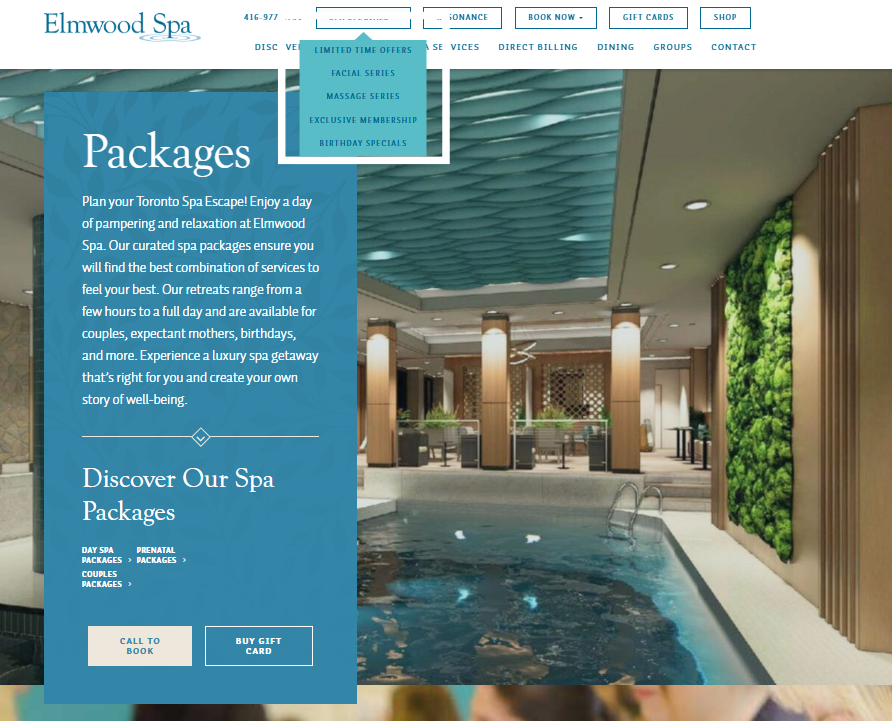
Turn your menu into real web pages. Each massage therapy, facial, and body treatment needs its own page, and so does any high-earning beauty treatment, such as waxing, nails, or lash work. This is SEO for spa services at its simplest: one page per treatment type.
A strong treatment page includes:
- A headline with the treatment and the city.
- A plain description of what the treatment is and who it’s for.
- What happens step by step, how long it takes, and what it costs.
- The therapist’s credentials and photo.
- Real photos of the room and the experience.
- Reviews from guests who had that treatment.
- Answers to common questions, such as who should avoid it.
- A clear booking button near the top and again at the end.
Write the copy yourself. Supplier descriptions appear on hundreds of other sites, and Google has no reason to prefer yours.
Give Packages, Memberships, and Locations Their Own Pages
A “Couples Spa Day” page can rank for anniversary and gift searches. A spa membership page can explain what’s included, how billing works, and how guests can pause or cancel. These are your most valuable pages, so link to them from every related treatment page. If you run more than one spa, give each location a page with its own address, parking details, landmarks, team, and reviews. Swapping the city name in a template doesn’t work.
| The On-Page Basics Headings: One H1 that names the treatment and the place, such as “Deep Tissue Massage Therapy in Kelowna, BC,” with clear H2 subheadings below. Title tags: Start with the main phrase: Day Spa in Ottawa | Massage, Facials & Spa Packages. Meta descriptions: Write like a person and end with a reason to book. URLs: Keep them short and readable, such as yourspa.ca/facial-treatments-ottawa. Internal links: Connect related pages with descriptive anchor text. Images: Use descriptive file names and alt text, such as “hot stone massage in a candlelit treatment room,” not “IMG_4821.” Calls to action: Place a visible booking button high on every page. |
Show Your Expertise and Build Trust
Google looks for signs of experience, expertise, and trustworthiness, especially for wellness services. Highlight these qualities across your website. Explain your hygiene and safety standards, showcase genuine client testimonials, and feature relevant awards or press mentions.
Be transparent about what each treatment can and cannot do, including any precautions or suitability requirements. These trust signals reassure potential clients and demonstrate your spa’s commitment to quality care.
Technical SEO for Spas That Turn Clicks Into Bookings
Technical SEO is the foundation under everything else. A beautiful site that loads slowly or hides pages from Google can’t rank. Cover these areas:
- Mobile usability. Most local searches happen on phones. Use tappable buttons, readable text, and click-to-call numbers.
- Page speed. Compress images, use dependable hosting, and avoid heavy autoplay video. Check Google’s Core Web Vitals in Search Console.
- HTTPS. Secure your site so booking forms and payment details are protected.
- Crawlability and indexing. Submit an XML sitemap, check your robots.txt file, and make sure important pages aren’t blocked by a “noindex” tag. Use Google Search Console to find pages Google can’t reach.
- Site structure. Guests and Google should reach any treatment page within about three clicks of your homepage.
- Broken links and redirects. Fix dead links, and redirect old pages to new ones when you change URLs so you keep your rankings.
- Duplicate content. Avoid repeating the same text across pages, especially location pages and supplier descriptions.
- Structured data. Add LocalBusiness markup (schema.org even has a “DaySpa” type) so your name, address, hours, and phone number match your Google Business Profile.
- Booking widget check. Some booking tools load inside a frame that Google can’t read. Keep your treatment details as real text on the page, with the widget as an add-on.
- Language versions. If you offer French pages, mark them properly so Google shows the right version to the right guest.
Run a technical check every quarter. Google Search Console flags indexing and mobile problems for free, and tools like PageSpeed Insights show what slows your pages. If you don’t have a developer, ask your SEO partner to prioritize fixes by impact: first anything that blocks Google from your pages, then speed, then the finer details.
Your Digital Growth Partner
Turn Your Spa Website Into a Booking Engine
Potens Digital is a spa SEO agency that fixes technical problems, builds treatment pages, and turns search visits into confirmed appointments.

Off-Page SEO for Spas: Build Trust Across the Web
Off-page SEO strengthens your spa’s reputation through backlinks, brand mentions, and local partnerships. Links from trusted, relevant websites can signal credibility to Google and help potential clients find your treatments.
Build links through spa-relevant partnerships:
- Hotels and resorts that recommend spa treatments to guests
- Wedding planners and bridal boutiques promoting pre-wedding facials and packages
- Physiotherapists and chiropractors referring clients for complementary wellness treatments
- Gyms and yoga studios partnering on wellness offers
- Corporate wellness programmes booking employee spa packages
- Skincare brands listing your spa as an authorized stockist
- Local lifestyle blogs and magazines featuring spa recommendations
- Community organizations and Canadian business directories listing your spa
Offer value through exclusive guest perks, joint spa packages, or expert skincare advice. Then request a relevant mention or backlink. Avoid paid link schemes and low-quality directories that can put your search visibility at risk.
Social media can also increase awareness of your treatments and encourage more people to mention or link to your spa online.
How to Earn Spa Backlinks
- Choose relevant partners whose audiences are likely to book your treatments.
- Propose a mutual benefit, such as a seasonal spa package or referral offer.
- Make linking easy by sharing your logo, a short spa description, and the relevant booking or treatment page.
- Follow up professionally and thank partners when your spa is featured.
Prioritize quality over quantity. A handful of relevant local backlinks can be more valuable than dozens of links from unrelated websites.
Reach Guests Before They’re Ready to Book with a Solid Content Strategy
Content strategy decides what you publish and why…
Content marketing puts it in front of the right people. Together, they reach guests early in their research and give AI search tools reliable pages to learn from.
Plan Content Around the Guest’s Questions
Start with the questions your front desk already answers, and match each to a stage:
- Learning: What to expect at your first massage therapy session. How to prepare for facial treatments and care for your skin afterwards.
- Comparing: Massage or facial: which is better for stress? How much does a day spa visit cost in Canada?
- Deciding: The best spa packages for couples, brides, and Mother’s Day. Why choose a spa membership?
Write each piece the same way. Answer the question in the first two sentences, add detail under clear subheadings, and finish with a link to the related treatment page and a booking button. Short, useful articles beat long, vague ones.
Choose the Right Content Types
Create engaging, service-focused content that showcases your spa treatments, highlights their benefits, and communicates what sets your spa apart. Use a mix of formats to build trust, strengthen your online visibility, and encourage more visitors to book an appointment. Clearly mention the qualifications of expert massage therapists, nail technicians, medical estheticians and fitness practitioners working at your Canadian Spa!
Here’s how you can deliver the best type of content to the audience:
- Treatment guides explaining facials, massages, body scrubs, and other spa services
- FAQ pages covering treatment costs, preparation, benefits, and aftercare
- Profiles of professionals highlighting qualifications, specialties, and experience
- Seasonal landing pages promoting gift cards, bridal packages, and holiday spa deals
- Short videos showcasing treatment rooms, spa experiences, and what clients can expect
Connect related content through internal links. For example, create a main guide to facial treatments and link it to pages about specific facials, skincare advice, aftercare, and facial packages. This structure strengthens topical relevance and guides potential clients towards booking.
Publish on the Canadian Calendar
Google needs weeks to find and rank new pages, so publish early.
| Season | What Guests Search | What to Prepare |
| Winter (Dec to Feb) | Gift cards, dry skin, sore muscles, couples packages | Boxing Day and Valentine’s offers, hydrating facial pages |
| Spring (Mar to May) | Mother’s Day, bridal prep, skin reset | Gift card promos by mid-April, bridal party package pages |
| Summer (Jun to Aug) | Waxing, body treatments, weekend getaways | Body treatment pages, updated Google Maps details |
| Fall (Sep to Nov) | Stress relief, back-to-routine, holiday gifts | Membership push, early holiday gift card campaign |
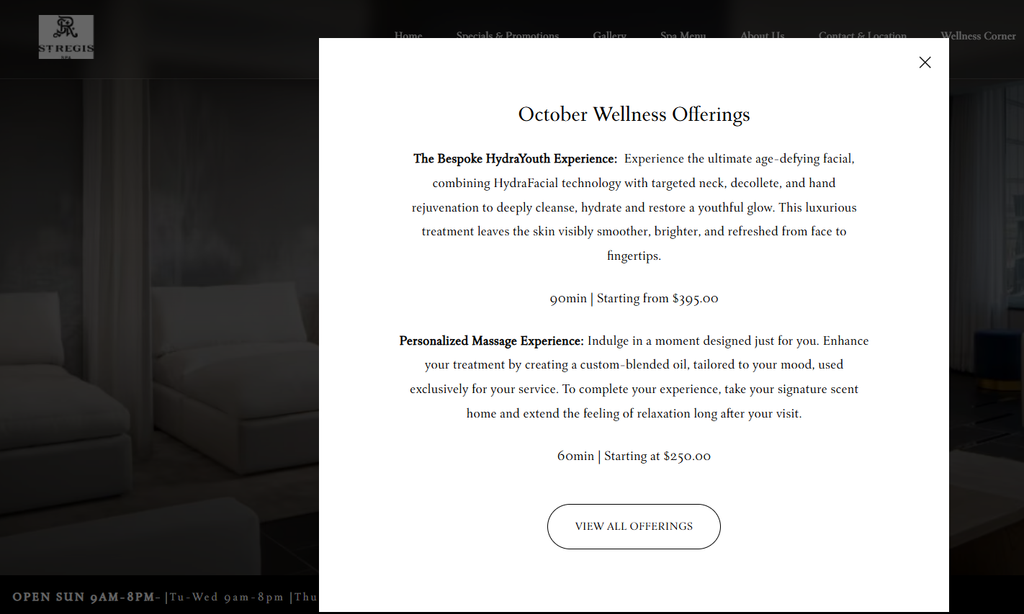
You can also consider adding seasonal offer pop-ups to your website to highlight limited-time treatments. Check the example below:
Turn Rankings Into Bookings, and First Visits Into Memberships
A high Google ranking means little if visitors struggle to book. Create a three-tap booking process: click Book Now, select a treatment and time, then confirm the appointment.
Make booking easy with clear prices, visible booking buttons, click-to-call numbers, transparent cancellation policies, and prompt enquiry responses. Test the booking process on your phone monthly to identify steps that may discourage potential clients.
Display prices, deposits, and cancellation terms before checkout to set clear expectations. Then encourage repeat visits through relevant membership offers, personalized thank-you messages with review links, and follow-ups that invite gift card recipients to explore your treatments.
For example, a $110 first visit followed by six months of an $85 monthly membership generates $510 in additional revenue. These figures are illustrative and exclude costs. A smooth booking process and consistent follow-up can turn first-time guests into loyal clients.
How to Measure Spa SEO: Five Numbers That Matter
Rankings mean little unless they lead to bookings. Track these five in Google Analytics 4, Google Search Console, and your booking system:
- Bookings and calls from organic search.
- Google Business Profile actions: calls, directions, website clicks, and booking clicks.
- Rankings for ten to fifteen treatment-and-city phrases.
- Revenue by service and package.
- New memberships and repeat visits.
Set a baseline first. Before you change anything, record your current calls, bookings, and rankings so you can show real progress at month three and month six. Review the numbers monthly. If a report leads with impressions and never mentions bookings, ask where the bookings are.
| A Realistic 90-Day Spa SEO Roadmap SEO builds over time, and timelines vary with your city and competition. A solid first quarter looks like this: Days 1 to 30: Audit your site, fix technical issues, optimize your Google Business Profile, clean up listings, and set up tracking. Days 31 to 60: Build your treatment, package, membership, and location pages. Start your review process. Days 61 to 90: Publish seasonal content, start local partnerships, and adjust based on the data. Month 4 and beyond: Keep publishing, build links, refine pages using real data, and expand to new treatments and neighbourhoods. |
Google Business Profile improvements can show results within weeks. Stronger organic rankings usually take several months. Expect small wins first, such as more profile views and calls, followed by steady growth in website bookings. To judge the return, work out what a typical new guest is worth over a year, then calculate how many extra bookings per month would cover your investment.
Should You Hire a Spa SEO Agency in Canada?
You can manage some SEO tasks yourself, such as completing your Google Business Profile, collecting client reviews, and creating useful service pages. However, hiring a spa SEO agency in Canada may be worthwhile if you face strong competition, operate multiple locations, have limited time, or struggle to improve your search rankings.
Look for a trusted spa digital marketing agency in Canada like Potens Digital with experience working with spas, wellness businesses, or other appointment-based services. Its proposal should explain which spa SEO services are included, such as keyword research, Local SEO, On-page optimization, technical SEO, link building, content creation, and monthly performance reports. Ask to review a sample report before signing a contract.
Before choosing an agency, ask these questions:
- Which spa SEO services are included in the monthly fee, and which cost extra?
- How do you select keywords that target my treatments and attract potential clients?
- Will I retain ownership of my accounts and receive reports on enquiries and bookings, not just rankings?
- What SEO practices do you use, and how do you manage reviews and backlinks?
- Do you understand the Canadian market and the local directories relevant to my business?
| Watch for warning signs such as guaranteed number-one rankings, secret SEO methods, purchased reviews or backlinks, and generic location pages that only replace one city name with another. A trustworthy spa marketing agency in Canada will explain its strategy, report on measurable results, and be honest about what it can and cannot control. |
Seven Spa SEO Mistakes That Quietly Cost You Bookings
- Hiding prices completely. Even “starting from” prices attract better-fit guests.
- Training guests to wait for deals. Lead with value, not constant discounts.
- Leaving Google messages unanswered. A slow reply sends guests to the next spa.
- Copying one page for every location. Each page needs its own details.
- Using a PDF menu. Guests and Google both struggle to read it.
- Ignoring mobile. Test your site on a phone every month.
- Tracking nothing. If you can’t see which searches become bookings, you’re guessing.
Your Spa SEO Action Plan for More Bookings
Use this checklist to strengthen your spa’s search visibility, reach more local clients, and turn website visits into appointments.
- Keyword Research: Identify treatment and location-based keywords, then assign a clear focus to each relevant page.
- Local SEO: Optimize your Google Business Profile with accurate business details, treatment information, updated photos, and booking links.
- Client Reviews: Encourage satisfied clients to leave honest reviews and respond professionally to all feedback.
- On-Page SEO: Create dedicated pages for individual treatments, spa packages, and memberships instead of relying on a PDF menu.
- Technical SEO: Check mobile usability, page speed, HTTPS security, XML sitemaps, and structured data to make your website easier to access and understand.
- Off-Page SEO: Build your website’s credibility through relevant backlinks from local businesses, hotels, wedding vendors, and wellness partners.
- Content Marketing: Publish useful articles about treatments, skincare concerns, seasonal offers, and common client questions.
- Performance Tracking: Use Google Analytics 4 and Google Search Console to monitor organic traffic, search visibility, enquiries, and completed bookings.
Start with the areas that need the most attention, then review your progress monthly. Consistent improvements can strengthen your spa’s online presence and create more opportunities to turn local searches into bookings.
| SEO Guides for Other Industries: SEO for Cleaning Companies SEO for Photographers SEO for Auto Repair Shops SEO for Glass Companies SEO for Interior Designers |
Frequently Asked Questions for Spa SEO in Canada
Is SEO worth it for a small day spa?
Yes. Local SEO lets a single-location day spa compete for nearby guests without relying only on ads or discounts. Start with your Google Business Profile, a steady review habit, and dedicated pages for your core treatments.
What’s the difference between Local SEO and regular SEO?
Local SEO helps nearby guests find your spa through Google Maps, the local pack, and city-based searches. Regular SEO focuses on ranking your website pages. Spas need both, but Local SEO usually brings the fastest results.
How long does spa SEO take to work?
Google Business Profile improvements can show results within weeks. Stronger organic rankings and steady bookings usually take several months, and your city’s competition affects the timeline.
Do I need a separate page?
Not at first. Get your service pages and Google Business Profile right, then add content that answers real guest questions.
Can I do spa SEO myself?
Partly. Many owners manage their own profile and reviews well. A specialist helps most with technical fixes, link building, scaling content, and tracking what drives bookings.
Ready to Fill Your Appointment Book? Let Potens Digital Help
Your next loyal client could be one Google search away. Make sure they find your spa before they book with a competitor. At Potens Digital, we help Canadian spas turn online searches into real appointment opportunities with SEO strategies built around how guests find, compare, and choose spa services.
#1 – Target the Right Searches: Identify the keywords potential guests use when looking for your treatments, packages, and spa services.
#2 – Own Your Local Visibility: Optimize your Google Business Profile so nearby clients can find your spa when they’re ready to book.
#3 – Turn Website Visits Into Bookings: Improve your website’s content, structure, speed, and technical performance so visitors can explore your services and book appointments more easily.
#4 – Build Trust Before the First Visit: Strengthen your website’s authority with relevant local links and useful content that answers clients’ questions and showcases your expertise.
#5 – Get Found in AI Search: Prepare your spa for AI-powered search experiences so potential guests can find your business across evolving search platforms.
Whether you run a boutique day spa, a wellness clinic, or a multi-location brand, our SEO experts in Canada create strategies that connect your treatments with the people searching for them. Let Potens Digital turn your spa’s search visibility into more enquiries, more appointments, and a fuller booking calendar.
Your Digital Growth Partner
Turn Search Visibility Into a Spa Full of Bookings
Our SEO experts in Canada help your spa rank higher on Google, reach more local clients, and turn searches into bookings with targeted SEO strategies that grow your business.

