

A comprehensive digital marketing guide to building organic search dominance for architects.
Securing high-value commercial and custom residential projects requires far more than word-of-mouth referrals or an aesthetic portfolio. Modern clients, property developers, and homeowners rely heavily on search engines to discover design talent, evaluate technical expertise, and shortlist firms before making initial contact.
Implementing a robust digital strategy transforms a passive online portfolio into an active, client-generating asset. When prospective clients search for design expertise, search engine optimization ensures your firm appears prominently at the exact moment design intent meets commercial budget.
Key Takeaways for Architecture Firm Growth
- Local Search Dominance – Optimizing your Google Business Profile and local landing pages ensures your firm appears in the high-converting Local 3-Pack for high-intent searches like “residential architect near me.”
- Depth Over Aesthetics – High-resolution photo galleries alone fail to index effectively. Structuring project case studies around technical specs, zoning challenges, and budget parameters provides maximum search visibility and builds immediate client trust.
- Information Gain Content Strategy – Building comprehensive guides around regional building codes, adaptive reuse, permitting workflows, and local zoning laws captures prospective developers and homeowners in early research stages.
- Technical Image Optimization – Implementing Next-Gen image formats (WebP/AVIF), responsive picture tags, and compressed architectural renders maintains site speed without sacrificing visual presentation.
- Generative Engine & AI Overview Preparation – Entity-based SEO and structured schema markup position your practice to be cited directly within Google AI Overviews and conversational AI search tools.
The Canadian Architectural Market – Search Trends & Lead Dynamics
Understanding search behaviour across key metropolitan areas, such as Toronto, Vancouver, Calgary, and Montreal, reveals how modern clients research design services. Rapid urban density shifts, heritage conservation mandates, and green building standard regulations drive modern architectural search queries.
Data from Statistics Canada underscores steady investment in non-residential and residential construction across major urban centers. As competition intensifies, firms relying solely on traditional networking face shrinking profit margins.
| Metropolitan Region | High-Intent Monthly Queries | Top Growth Categories | Average Lead Value (Project Retainer) |
| Greater Toronto Area (GTA) | 14,500+ | Multi-Family Infill, Net-Zero Residential, Adaptive Reuse | $25,000 – $150,000+ |
| Greater Vancouver Area | 9,200+ | Laneway Housing, Mass Timber, Heritage Restoration | $20,000 – $120,000+ |
| Calgary & Edmonton | 6,100+ | Commercial Interior Architecture, Urban Infill, Industrial | $15,000 – $85,000+ |
| Montreal Metropolitan | 8,400+ | Sustainable Urban Planning, Boutique Commercial, Residential | $18,000 – $95,000+ |
Investing in a specialized architecture digital marketing agency in Canada positions Canadian practices to capture these high-margin retained projects directly from organic search.
Suggested Further Reading – Comprehensive Marketing Guides
To build a fully integrated marketing engine across your architectural practice, explore our complete series of specialized industry guides:
- Real Estate SEO Strategy – How to partner with potential owners and clients through search.
- Interior Architecture & Spatial Design Marketing – SEO for Capturing high-end commercial fit-out clients.
- SEO for Construction Companies: How Builders Can Get More Projects Online
- AEO & GEO Mastery for AEC Practices – Preparing your brand for artificial intelligence search environments.
1. What Is SEO for Architects?
SEO for architects is the specialized practice of optimizing an architecture firm’s website, project portfolio, local listings, and digital authority to rank higher in search engine results pages (SERPs). Unlike generic search strategies, architect SEO targets long sales cycles, high contractual values, and distinct visual-to-technical search behaviours.
Effective architecture company SEO connects your design solutions with property owners, commercial developers, and public sector decision-makers precisely when they perform research.
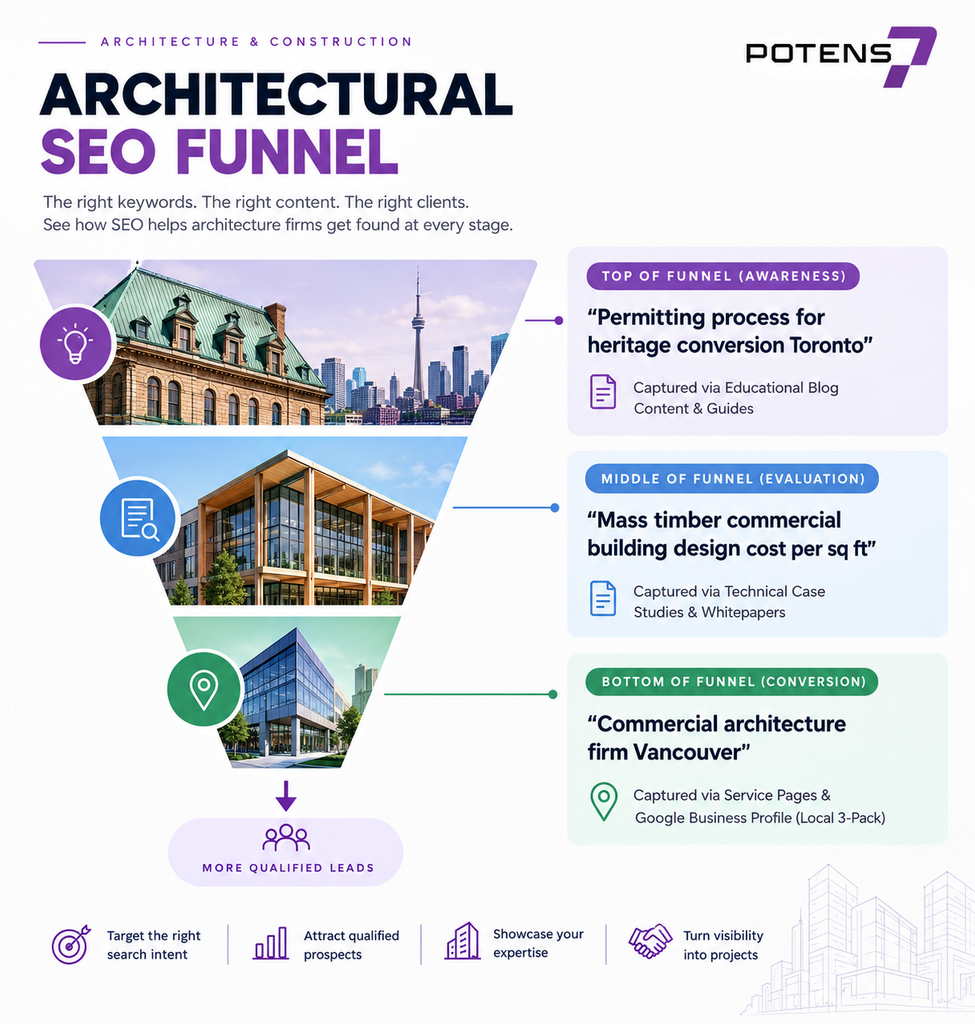
2. Why SEO Is Significant for Architects
Relying exclusively on client referrals limits practice growth and leaves firms vulnerable to market cycles. Modern decision-makers perform extensive background research before initiating a project call.
Implementing dedicated SEO for architecture firms yields distinct competitive advantages:
- Captures High-Intent Commercial Clients – Developers searching for “adaptive reuse architect SEO Canada” or “industrial architect SEO services in Canada” have capital allocated and immediate timeline requirements.
- Shortens the Sales Cycle – Transparent project case studies, clear regulatory explanations, and detailed service descriptions establish credibility before the first meeting.
- Builds Sustainable Digital Assets – Unlike paid advertising campaigns that cease lead generation the moment spending stops, organic architect SEO marketing delivers long-term client acquisition.
- Protects Market Share Against Competitors – Partnering with a specialized architect SEO agency ensures your practice claims top search real estate before regional competitors dominate local rankings.
3. SEO Keyword Research For Architects
Successful SEO for architecture businesses in Canada relies on mapping search terms to client intent. Prospective clients use varying terminology based on their project stage.
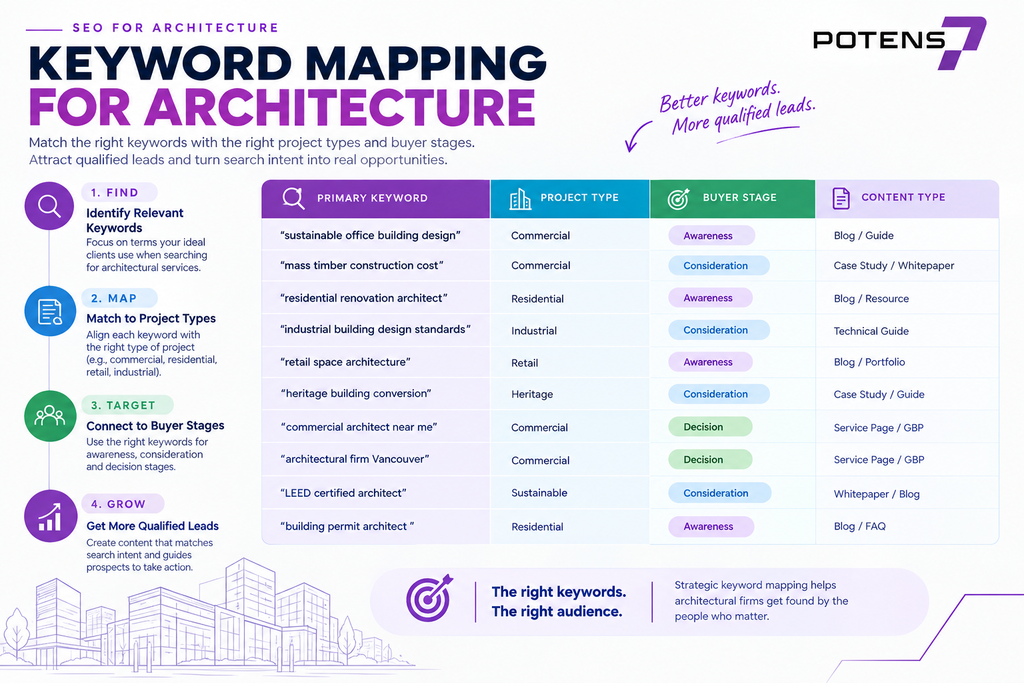
High-Intent Keyword Matrix for Architectural Practices
| Search Intent | Keyword Category | Example Target Keywords | Target Page Type |
| Transactional | High-Intent Agency Searches | architect SEO company, architecture marketing agency, architect SEO agency Canada | Core Service Pages, Homepage |
| Commercial | Specialized Services | SEO for architects, architect SEO, architect SEO marketing | Architecture Service Pages |
| Local / Geo-Targeted | Regional Services | architect SEO Canada, architecture digital marketing agency canada, SEO for architecture practices Markham | Location Landing Pages |
| Informational | Technical & Educational | architecture digital marketing Toronto, architecture company SEO, architecture firm SEO | Blog / Resource Guides |
When executing keyword strategy, incorporate terms across all portfolio pages to maintain comprehensive topical relevance.
4. Google Business Profile Optimization for Architects
Your Google Business Profile (GBP) serves as the digital front door for local commercial and residential inquiries. A fully optimized profile directly powers your placement on Google Maps.
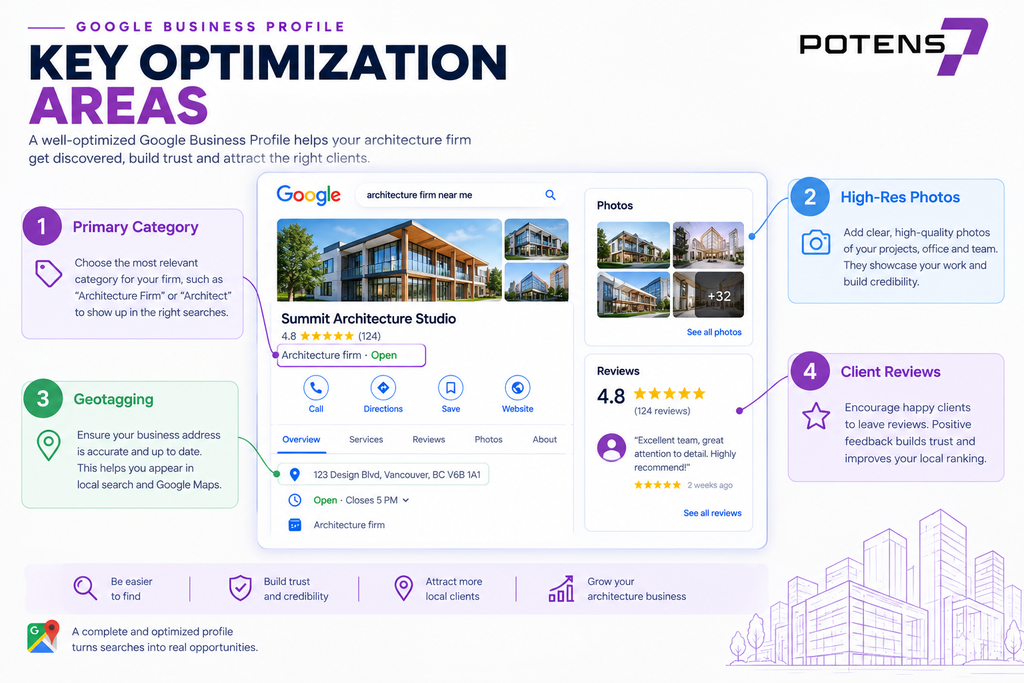
Strategic Step-by-Step Profile Optimization
- Primary & Secondary Categories – Select Architect or Architectural Designer as your primary category. Add explicit secondary categories such as Custom Home Builder Canada, Interior Designer, or Urban Planner.
- High-Resolution Architectural Imagery – Upload professional photography organized by project type (Residential Architecture, Commercial Architecture, Interior Architecture). Ensure image metadata includes accurate location tags.
- Detailed Service Catalogue – Itemize individual service offerings under your profile, matching terms like Building Design, 3D Architectural Visualization, and Construction Documents.
- Regular Updates & Posts – Publish monthly updates featuring completed project milestones, design awards, or recently published case studies.
5. Local SEO for Architects
Executing effective local SEO requires aligning off-site citations with on-site regional indicators. Search engines evaluate geographic proximity and localized prominence to determine local pack positions.
- Ensure exact Name, Address, and Phone number (NAP) consistency across all regional directories.
- Embed a customized, responsive Google Map on key contact and regional landing pages.
- Develop dedicated localized content targeting regional planning regulations, conservation authorities, and municipal guidelines.
6. On-Page SEO for Architects’ Websites
On-page optimization transforms visual architectural work into indexable semantic data for search crawlers.
Essential On-Page Elements
- Title Tags & Meta Descriptions – Include primary terms such as SEO for architecture practices alongside regional qualifiers. Keep titles under 60 characters and descriptions under 160 characters.
- Heading Hierarchy (H1–H4) – Maintain strict semantic hierarchy. Use H1 for primary page titles, H2 for major structural topics, and H3/H4 for sub-points.
- Image ALT Attributes – Avoid generic alt text like “IMG_4092.jpg”. Use descriptive alt text such as “Modern timber-framed commercial building interior architecture project in downtown Vancouver.”
7. Service Page Optimization for Architects
Generic single-page service listings fail to rank for competitive search terms. Each design discipline demands its own dedicated service page optimized for specific client needs.
Core Architecture Service Pages to Build
- Residential Architecture – Custom homes, multi-family infills, and net-zero residential design.
- Commercial Architecture – Office buildings, retail spaces, industrial facilities, and hospitality developments.
- Interior Architecture – Spatial layout planning, tenant fit-outs, and commercial interiors.
- Urban Planning & Landscape Architecture – Site master planning, zoning approvals, and land development strategy.
- Adaptive Reuse & Heritage Preservation – Modernizing historical structures while maintaining heritage compliance.
To review an actionable, step-by-step audit framework for your service infrastructure, download our Complete SEO Guide & Checklist.
8. Local Landing Pages for Architects
When expanding into adjacent cities or suburban markets without physical branch offices, dedicated local landing pages establish organic visibility for surrounding regional terms.
Blueprint for High-Converting Regional Pages
- Localized Project Spotlights – Feature completed projects built specifically within target municipal boundaries.
- Municipal Permitting Insights – Detail experiences navigating local building departments, heritage boards, or zoning committees.
- Geographic Schema Integration – Implement precise GeoCoordinates within page-level structured data markup.
9. Content Marketing for Architects & Information Gain
Google prioritizes content that delivers original insight beyond basic surface-level summaries. For architects, information gain means sharing proprietary technical expertise, regulatory navigation strategies, and detailed design methodologies.
High-Value Article Content Topics
- Navigating municipal variance applications and public zoning hearings.
- Cost analysis comparing mass timber, structural steel, and reinforced concrete in commercial developments.
- Incorporating passive house design strategies into modern residential builds.
- Managing construction documentation workflows to prevent project delays.
For tactical guidance on crafting high-performing content structures, consult our specialized strategy breakdown on Potens Digital.
10. Internal Linking for Architects’ Websites
Internal linking guides search engine crawlers through your portfolio structure while distributing authority from top-performing pages to specialized case studies.
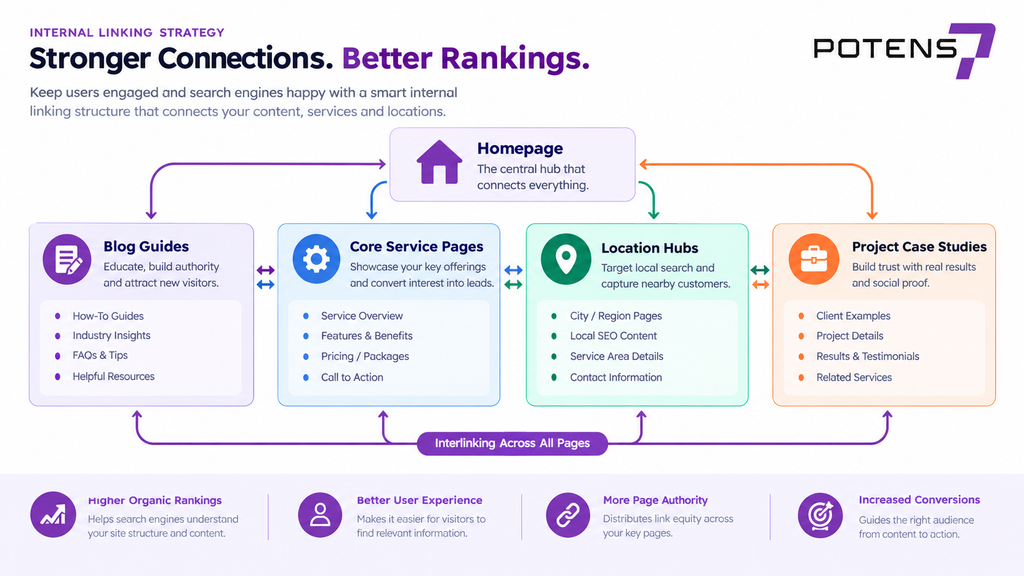
Strategic Link Distribution Pattern
- Link from high-traffic blog guides directly to corresponding architect SEO service landing pages.
- Contextually link portfolio case studies back to primary service categories (e.g., anchor text pointing to Commercial Architecture).
- Implement structured breadcrumb navigation across all subpages.
11. Technical SEO for Architects – Speed & Image Optimization
Architectural websites are heavily visual. Large, uncompressed high-resolution images severely penalize page load speed, triggering higher bounce rates and lower search rankings.
Technical Performance Matrix
| Step | Optimization Action | Technical Implementation / Method | Expected Impact / Outcome |
| 1. Convert Formats | Shift from PNG/TIFF to WebP or AVIF | Re-encode high-resolution renders and photography into Next-Gen lightweight formats. | Decreases image file size by 30%–80% without loss of visual quality. |
| 2. Responsive SRC | Implement srcset attributes | Serve scaled image dimensions tailored to mobile, tablet, and desktop viewports. | Prevents mobile devices from downloading unnecessarily large desktop-sized assets. |
| 3. Lazy Loading | Apply loading=”lazy” | Defer loading off-screen image assets until the user scrolls near them. | Significantly lowers initial page payload and improves Core Web Vitals (LCP). |
| 4. CDN Delivery | Serve via Global Edge Networks | Route media delivery through geographically distributed content delivery networks. | Reduces latency and speeds up image load times for regional and international visitors. |
| 5. Caching Policy | Enable Browser Caching | Configure HTTP headers for long-term static asset retention on returning visits. | Speeds up multi-page navigation across portfolio galleries and case studies. |
Extensive research by Google on Mobile Page Speed demonstrates that as page load time increases from 1 second to 3 seconds, the probability of a mobile bounce increases by 32%. Keeping asset payloads light directly preserves campaign conversion performance.

Your Digital Growth Partner
Eliminate Site Speed Bottlenecks Without Sacrificing Visual Quality
High-resolution renders shouldn’t compromise your Google rankings. We implement advanced Next-Gen image compression and responsive loading protocols that keep your visual portfolio pristine and lightning-fast across all devices.

12. Reviews & Online Reputation Management
Client testimonials serve as powerful social proof for prospective clients and strong local search ranking signals for search engines.
- Systematic Review Acquisition – Request Google reviews upon reaching major project milestones (such as occupancy permit approval or completion).
- Keywords in Testimonials – Encourage clients to mention specific services and locations in their reviews (e.g., “The best custom residential architect in Calgary”).
- Active Review Responses – Respond professionally to all reviews within 48 hours, highlighting your practice’s commitment to service quality.
13. E-E-A-T for Architects (Experience, Expertise, Authoritativeness, Trustworthiness)
Google evaluates site quality using E-E-A-T criteria. Because architectural decisions carry significant financial and structural impact, establishing clear authority is vital.
Demonstrating Design & Technical Authority
- Licensing & Professional Affiliations – Display registration details with official provincial or national associations (e.g., OAA, AIBC, AAA, RAIC, AIA).
- Detailed Principal Bios – Highlight educational credentials, professional design awards, published work, and speaking appearances.
- Transparent Firm Details – Feature clear physical address details, leadership profiles, and verifiable contact information across all pages.
14. Architects Schema Markup (Structured Data)
Schema markup serves as a semantic translator that converts standard web content into explicit, structured code that search engines can read, process, and index without ambiguity. For architectural practices, implementing JSON-LD (JavaScript Object Notation for Linked Data) structured data is vital because traditional design portfolios are heavily visual and often lack the dense text blocks that search crawlers rely on to decipher business context. By embedding specialized schema markup, such as @type – ArchitecturalFirm or @type – ProfessionalService, into your website’s code, you explicitly communicate your firm’s name, physical geographic coordinates, corporate address, contact numbers, primary service offerings, price points, and active social profiles directly to Google. Furthermore, you can apply schema markup to individual project case studies using @type – SingleFamilyResidence or @type – CivicStructure linked to your firm as the creator. This structured clarity directly improves your chances of earning rich snippets in search results, secures your position in Google’s Knowledge Graph, and ensures your firm is correctly identified, categorized, and cited across AI-driven search environments like Google AI Overviews and conversational assistants.
15. Voice Search & AI Overviews for Architects
Search engine environments are evolving rapidly with AI-driven summaries and conversational search tools. Optimizing your architectural content for generative search requires structured data clarity and clear factual answering formats.
Generative Optimization Rules
- Clear Concise Definitions – Structure answers to common industry queries in clear 40–50 word paragraphs directly below header tags.
- Entity-Dense Copywriting – Use precise architectural terminology (e.g., embodied carbon, building envelope performance, zoning variance).
- Structured Tables & Listicles – Present technical comparisons in clear markdown tables to simplify AI data extraction.
For an in-depth breakdown on structuring web copy for conversational search tools, refer to our detailed guide on How to Optimize for Google AI Overview.
Your Digital Growth Partner
Future-Proof Your Architectural Brand for Google AI Overviews
Search engine environments are evolving rapidly into generative answers. We optimize your website’s entity architecture and schema markup so AI models accurately cite your firm for regional project searches.

16. Local Citations & Directory Listings
Establishing accurate directory citations across industry platforms reinforces geographic authority and builds backlink profile diversity.
Priority Directory Platforms for Architects
- Architectural Directories – Architizer, ArchDaily, Archello, Houzz.
- Commercial Real Estate Networks – Urban Land Institute (ULI), LoopNet, local chambers of commerce.
- General Directories – Google Business Profile, Apple Maps, Bing Places, Yelp for Business.
17. Link Building for Architects
High-quality authority links signal to search engines that your practice is recognized as an industry leader. Focus on acquiring contextually relevant backlinks from AEC publications and industry organizations.
Sustainable Backlink Strategies
- Design Award Submissions – Enter regional and national architectural awards competitions that link back to project landing pages.
- Guest Editorial Contributions – Write technical design articles for real estate, urban planning, and construction publications.
- Digital PR & Project Features – Submit completed project photography and design statements to architectural design publications like Canadian Architect or Azure Magazine.
- Supplier & Vendor Partnerships – Partner with structural material manufacturers, lighting designers, and general contractors to secure project credits and reciprocal links.
18. Competitor Analysis for Architects
A comprehensive competitor audit reveals content gaps, backlink profile opportunities, and targeted keyword expansion strategies within your regional market.
Competitor Evaluation Checklist
- Topical Gap Analysis – Identify high-intent search terms driving organic traffic to competing firms that are missing from your current site structure.
- Backlink Profiling – Audit competing firms’ backlink profiles using tools like Ahrefs or Semrush to identify editorial outreach opportunities.
- UX & Conversion Assessment – Evaluate competitor project navigation, contact form placements, and digital lead capture mechanisms.
19. Architects SEO Analytics & Conversion Tracking
Tracking digital campaign performance ensures clear reporting and measurable marketing return on investment.
Key Analytics Metrics to Track
| Metric / KPI | Objective & Context | Tracking Methodology & Tools | Success Indicator / Goal |
| 1. Organic Traffic Growth | Filtered by local commercial and design intent queries | Google Analytics 4 (GA4) with filtered segments excluding brand searches | Consistent month-over-month increase in qualified, non-branded organic visitors |
| 2. Local Pack Rankings | Monitored across key target geographic markets and postal/ZIP codes | Local rank tracking tools (e.g., BrightLocal, Semrush Local) mapped to target grid locations | Top 3 position on Google Maps for high-value terms like “commercial architect near me” |
| 3. Inquiry Conversions | Direct lead actions including consultation requests, phone calls, and form submissions | Custom GA4 Event Tracking, Google Tag Manager, and call tracking software | Higher conversion rate from organic visitors reaching key contact and landing pages |
| 4. Engagement Duration | Time spent interacting with technical case studies, portfolio galleries, and guides | GA4 Average Engagement Time and Scroll Depth metrics on project pages | Higher average engagement time indicating prospective clients are actively evaluating work |
| 5. Assisted Conversions | Tracking multi-touch client journeys from initial informational discovery to consultation | GA4 Attribution Models (Data-Driven / Linear Attribution) | Demonstrating SEO’s contribution to high-value project inquiries across long research cycles |
20. Architects Website Conversion Rate Optimization (CRO)
Driving organic search traffic is only half the battle; your website must convert casual site visitors into active project inquiries.
- Prominent Calls-to-Action – Place explicit conversion prompts (e.g., “Schedule a Feasibility Consultation”) above the fold and at the end of case studies.
- Frictionless Form Design – Keep contact forms short, requesting only essential initial details (project scope, location, estimated budget, timeline).
- Embedded Proof Points – Feature client quotes, awards, and licensing credentials directly alongside inquiry forms.
21. Architects SEO vs. Google Ads (PPC) In Canada
Both organic search optimization and pay-per-click advertising offer distinct advantages for architectural lead generation. Balancing both models creates an effective client acquisition strategy.
| Strategy Feature | Search Engine Optimization (SEO) | Google Ads (PPC) |
| Time to Results | 3 to 6 months for sustained growth | Immediate traffic upon campaign activation |
| Long-Term ROI | Compounding returns; zero cost per click | Traffic stops when daily budget ends |
| Trust Factor | High organic trust; higher conversion rate | Visible ad labels reduce click-through rates |
| Cost Dynamics | Predictable agency management investment | Fluctuating cost-per-click based on auction |
22. How Long Does Architects SEO Take?
SEO is a long-term compound growth strategy. Because architectural sales cycles span months or years, organic search growth follows a distinct timeline.
- Months 1–2 (Foundation) – Technical site cleanup, speed optimization, local citation updates, schema implementation, and keyword mapping.
- Months 3–4 (Content Expansion) – Service page rebuilding, case study optimization, and strategic internal linking.
- Months 5–6 (Authority Building) – Editorial outreach, local pack placement gains, and initial conversion volume growth.
- Months 7–12+ (Compound Scaling) – Dominating high-intent search terms, expanding regional landing pages, and capturing consistent commercial project leads.
23. How Much Does Architect SEO Cost?
Investing in professional digital marketing varies based on firm size, regional market competition, and target growth objectives.
Typical Retainer Models
- Foundational Regional SEO – $2,500 – $4,500 / month (Ideal for boutique residential practices targeting a single metropolitan area).
- Competitive Multi-Regional SEO – $5,000 – $8,500 / month (Designed for mid-sized firms expanding commercial and residential services across multiple regions).
- Enterprise AEC Marketing Campaigns – $10,000+ / month (Comprehensive digital strategy for nationwide architectural and engineering practices).
Your Digital Growth Partner
Get a Customized Digital Growth Strategy for Your Practice
Stop guessing your digital marketing budget. Partner with our specialized Canadian agency to receive a tailored competitive gap analysis, technical audit, and clear multi-channel strategy designed for sustainable firm growth.
24. Why Do Your Architects Need Local SEO?
Local search optimization ensures prospective clients in your immediate geographic area locate your firm first when searching for specialized design services.
Without dedicated local optimization, your practice risks losing high-margin regional projects to competing practices that maintain optimized Google Business Profiles and localized landing pages.
25. Architects SEO Checklist
Follow this concise checklist to evaluate your practice’s search readiness:
- Claim and verify your Google Business Profile.
- Select accurate primary and secondary categories (Architect, Urban Planner).
- Compress all portfolio photography using WebP or AVIF formats.
- Build dedicated service pages for each distinct architectural discipline.
- Create individualized project case studies with rich technical details.
- Implement structured JSON-LD Schema markup (ArchitecturalFirm).
- Ensure exact Name, Address, and Phone (NAP) consistency across directories.
- Publish authoritative educational guides on local zoning and building codes.
- Establish Google Analytics 4 (GA4) and Search Console event tracking.
- Maintain an active outreach strategy for architectural awards and press features.
26. Frequently Asked Questions About Architects SEO
How do I optimize my architectural portfolio for Google search?
Avoid relying strictly on visual image galleries. Accompany every project gallery with at least 400–600 words of detailed project context, including design challenges, square footage, structural materials used, regional zoning hurdles, and final performance metrics.
Can architecture firms rank without writing blog articles?
While technical service pages and case studies form a strong ranking foundation, writing authoritative educational articles on zoning laws, permitting, and building costs captures clients earlier in their decision-making process.
What is the single most important ranking factor for local architects?
Google Business Profile optimization combined with high review volume and geographic proximity signals remains the primary driver for local 3-pack visibility.
27. How to Choose an Architect’s SEO Agency
Selecting the right digital growth partner is critical for ensuring campaign success and protecting brand prestige.
Evaluation Criteria
- Industry Specialization – Ensure the agency understands AEC terminology, long sales cycles, and visual asset constraints.
- Transparent Case Studies – Request verified ranking and lead growth documentation from previous client campaigns.
- White-Hat Technical Practices – Verify that the agency adheres strictly to search engine guidelines regarding link building and content creation.
Get Started With Architects SEO
Transforming your architectural website into a continuous source of high-margin project leads requires strategic technical execution, authoritative content design, and disciplined local optimization.
Ready to scale your design practice and dominate search rankings in your target market? Partner with a dedicated architecture digital marketing agency in Canada to build your customized growth roadmap today.

