



Why Your Business Can’t Afford to Ignore AI Automation in 2026
Ever get to the end of a long day and feel like you were busy, but not productive? You’re not alone. So many small business owners are stuck in a cycle of manual tasks. Things like data entry, scheduling, and answering the same customer questions over and over. It’s exhausting. And while you’re bogged down, your competitors seem to be speeding ahead, getting better at competing for online visibility.
But what if you could get that time back? Think about it. Research shows office workers can lose about 3 hours every day to repetitive computer tasks that could be automated. That’s a lot of time. With AI automation, you can hand off those boring jobs to smart software. This isn’t about sci-fi robots; it’s about practical tools that help you get more done.
You might be thinking, “AI sounds expensive and complicated.” A few years ago, you’d be right. But things have changed. Fast. Now, AI for small businesses is more accessible and affordable than ever. That’s why 78% of growing small and medium-sized businesses plan to spend more on AI next year, according to a Salesforce report. They know it’s the key to working smarter.
This article is your guide to figuring it all out. We’ll walk through the different types of AI automation solutions and show you how to choose the right AI automation companies for your specific needs. No confusing jargon. Just a clear path to help you grow your business and stop wasting time on tasks a machine can do for you.
Beyond the Buzzwords: What is Intelligent Automation vs. Basic Automation?
Let’s clear up some confusion. The term “automation” gets thrown around a lot. But not all automation is the same. Think of it like a coffee maker. Basic automation is like a simple drip machine with a timer. You set it to start at 7 AM, and it does exactly that. Every single day. It follows one rule: if it’s 7 AM, brew coffee.
That’s basic business process automation. It’s super useful for simple, repetitive jobs that never, ever change, like sending a standard welcome email to every new subscriber. It follows a strict “if this, then that” script. Simple. Predictable. But it breaks if something unexpected happens. If the new subscriber’s name is misspelt, the basic automation won’t notice or fix it. It just follows its one rule.
Now, intelligent automation is more like a high-tech espresso machine that learns how you like your coffee. It remembers you prefer an extra shot on Mondays. It might even suggest a new blend based on your past choices. It doesn’t just follow rules; it learns, adapts, and makes small decisions on its own. It’s a whole different level.
This is where the “AI” in AI automation comes in. Intelligent automation services can handle messy, real-world information. Think about customer emails. Some are happy, some are angry, and some are just asking a simple question. A basic tool can’t tell the difference. But an AI-powered system can read the email, understand the tone, and even sort it into the right department for a response. It handles unstructured data, which is just a fancy way of saying “stuff that isn’t organised neatly in a spreadsheet.”
So, the real difference is this. Basic automation makes you faster. Intelligent automation makes you smarter. It doesn’t just complete the task you gave it; it looks for better ways to get the work done and gives you insights to improve your whole strategy. It’s about moving from just doing things right to doing the right things.

The 4 Core Types of AI Automation Solutions for Growing Businesses
Okay, so we know intelligent automation is smart. But what does it actually do? It’s not one single thing. It’s more like a toolkit with different tools for different jobs. Thinking about the types of AI automation solutions available helps you figure out where to start. Most of them fall into four main buckets.
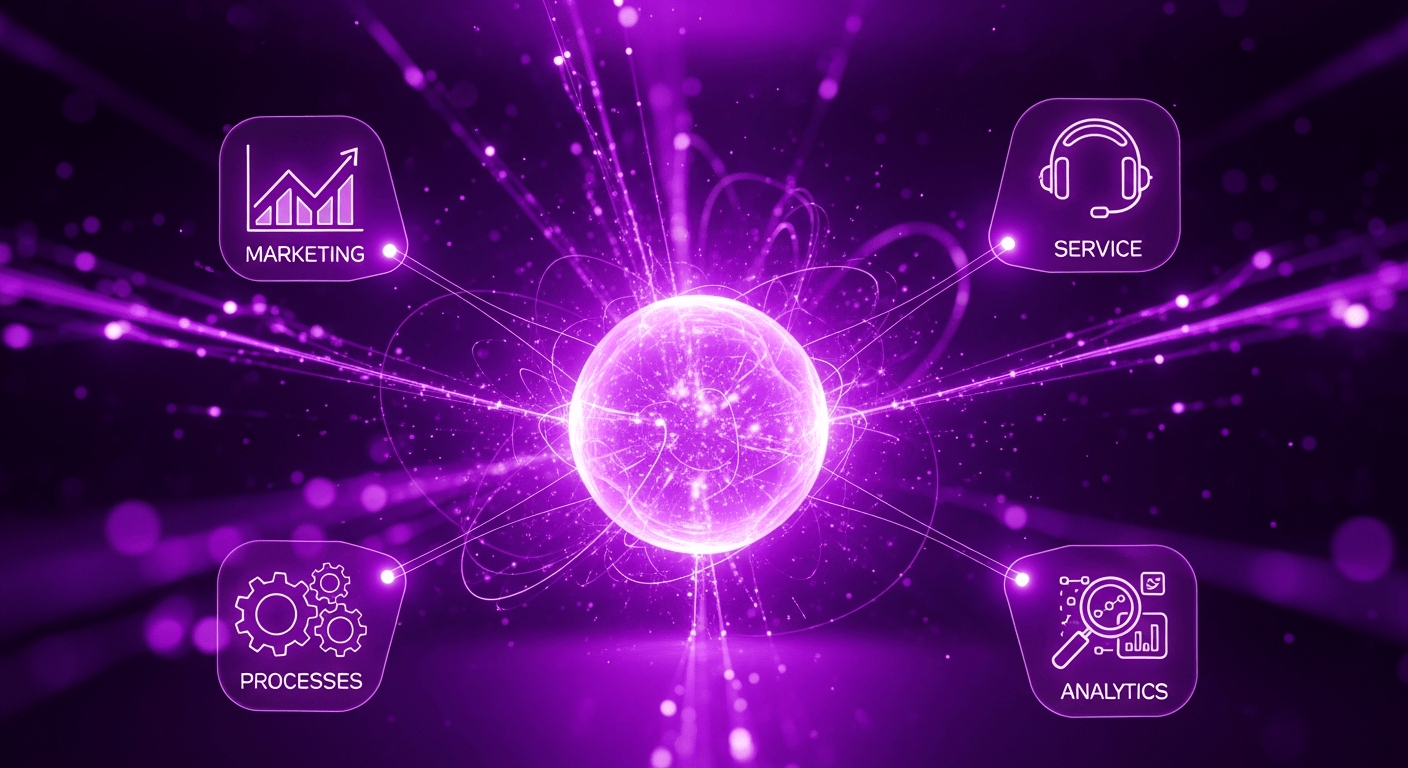
1. AI-Driven Marketing and Sales Automation
This is a big one for small businesses. You’re trying to find new customers without a giant marketing budget, right? This is where AI helps. It can automatically manage your ad spending, putting money toward what’s working and stopping what isn’t. It also makes personalisation easy. Instead of sending the same email to everyone, AI can help you send messages based on what a customer has looked at or bought before. One marketing agency even saw a 25% jump in conversions just by using AI to score their leads, which is a fancy way of saying it helped them focus on the people most likely to buy. This is a huge step up from basic email tools. With AI-driven marketing and sales automation, you’re not just sending messages; you’re building smarter relationships with customers.
2. Intelligent Customer Service Automation
Happy customers are the key to growth. But answering questions all day can drain your team’s time. This is where customer service automation shines. You’ve probably already talked to an AI chatbot. They can handle common questions 24/7, like “Where is my order?” or “What are your hours?” This frees up your human team for the tricky problems that need a real person’s touch. Plus, AI can do more than just chat. It can read an incoming support email, understand if the customer is upset, and send it to the right person to handle. This works. Studies have shown that teams using AI resolve about 15% more issues every hour. Less waiting for customers and a more focused team for you.
3. Automated Business Processes (AI-RPA)
This one sounds a little technical, but the idea is simple. Think about all the boring, repetitive computer tasks your team does. Copying data from a PDF invoice into your accounting software. Moving files from one folder to another. Onboarding a new employee by setting up their accounts. Robotic process automation (RPA) tools can do all of that. It’s like a digital employee who follows a script. But when you add AI, it gets way smarter. AI-powered RPA can read and understand documents that aren’t perfectly formatted. It can handle exceptions without breaking down. This is a huge part of business process automation that saves a ton of time and reduces human error.
4. AI-Powered Analytics and Insights
Wouldn’t it be great to have a crystal ball for your business? AI-powered analytics is pretty close. Instead of just showing you charts of what happened last month, it helps you understand why it happened and what might happen next. It can analyse your sales data to predict future trends. Or it can look at customer behaviour and flag who might be about to cancel their subscription, so you can try to win them back. For example, an e-commerce store used AI to forecast its inventory needs. This simple change cut their overstocking costs by 30%. These insights help you make smarter decisions based on data, not just gut feelings. It’s about knowing what’s around the corner.
A Strategic Framework for Evaluating AI Automation Companies
Okay, so you’re sold on the idea of AI. Awesome. But now comes the tricky part. How do you pick the right partner from all the AI automation companies out there? It feels a lot like hiring a key team member. You can’t just go with the first one you find on Google. You need a game plan.
Choosing the right partner is a big deal. The wrong choice can lead to wasted money and a lot of headaches. But the right one can completely change your business for the better. Let’s break down a simple four-point checklist to help you make a smart decision.

1. Industry Experience or Generalist?
You wouldn’t hire a plumber to fix your car, right? Same idea here. Some AI companies are generalists. They can handle basic tasks for any type of business. That might be fine if you just need a simple chatbot. But for core parts of your business, you want a specialist. A company that understands your industry knows the specific problems your customers have and the language they use. When you’re talking to potential partners, ask them straight up: “Have you worked with a business like mine before?” And then ask for proof. Seeing case studies with real results from your industry is one of the best ways to know you’re talking to the right people. This is a key part of learning how to evaluate AI vendors.
2. Do Their Tools Play Nice with Yours?
Imagine buying a fancy new coffee maker that only works with special, impossible-to-find coffee pods. Annoying, right? That’s what it’s like when your new AI tool doesn’t connect with the software you already use every day. Your CRM, your accounting software, your website, all these things are part of your “tech stack.” A good AI partner offers solutions that integrate smoothly with what you’ve already got. This avoids creating “data silos,” which are just lonely islands of information that don’t talk to each other. You want a seamless flow of information, not another manual copy-and-paste job. Make sure to ask about their integration capabilities early on.
3. Can They Grow with You? (And Will They Help You Learn?)
What you need today might not be what you need in two years. Your business is growing, and your tools need to keep up. This is called scalability. Ask potential AI automation companies how their platform handles growth. Will it slow down if you double your customers? What does it cost to add more users or features? Just as important is support and training. What happens when something goes wrong at 8 PM on a Friday? Who do you call? And how will they teach your team to use the new tools? Shockingly, many small businesses using AI don’t spend money on training, which is a huge mistake. A good partner will have a clear plan for support and make sure your team feels confident from day one. In fact, training gaps are a common issue for small firms, with a 5.2% difference in hiring vendors or consultants to integrate AI compared to large businesses.
4. Clear Pricing and Real-World Proof
Let’s talk money. Nobody likes surprise fees. Look for companies with transparent, easy-to-understand pricing. If their pricing model is confusing, that’s a red flag. But pricing is only half the story. You need to know if the investment is worth it. This is where you have to ask for the receipts. Literally, ask for case studies showing a clear return on investment (ROI). There are amazing stories out there, like a local HVAC company that saw a 595% ROI by automating its scheduling and follow-up. That’s the kind of proof you’re looking for. A great partner won’t just sell you software; they will show you how it’s going to make or save you money.
AI in Action: Real-World Scenarios for SMBs
All that theory about picking vendors is great, but what does this stuff actually look like on a random Tuesday afternoon? It’s one thing to talk about frameworks; it’s another to see how AI automation solutions work in the real world. Let’s look at a few examples of how small businesses are already using these tools to get ahead.

Scenario 1: The Online Boutique
Imagine an online store that sells handmade jewellery. The owner is great at creating new pieces but struggles with marketing. Everyone gets the same generic email. As a result, lots of shoppers add items to their cart but never finish checking out. By using an AI platform, the store can now send personalised product recommendations based on what a customer has viewed before. The system can even predict who is likely to abandon their cart and send them a friendly reminder or a small discount. This is a perfect example of AI for small businesses making a direct impact on sales. And it works; a huge majority of SMBs using AI report an improved ability to scale their operations.
Scenario 2: The Busy Service Provider
A small accounting firm faces a different problem. Their team spends hours each week answering the same questions and scheduling appointments. It’s time they could be spending on actual client work. They decide to implement an intelligent chatbot on their website. Now, the bot handles all the basic questions 24/7. It can qualify new leads by asking a few simple questions and then automatically schedule a consultation on the right person’s calendar. This one change is a massive win for their business process automation. They’ve cut down on administrative work and can respond to potential clients instantly, not hours later.
Scenario 3: The Local Restaurant Chain
Think about a family-owned group of three restaurants. They get tons of reviews online, but the owner doesn’t have time to read them all. They use an intelligent automation service to analyse customer feedback from Google and Yelp. The AI spots common themes, like people loving a new menu item or complaining about wait times at a specific location. The tool also helps them automate social media posts and optimise their local search listings. This kind of AI business solution helps them listen to their community and attract more foot traffic. The impact is real; across the country, AI is helping small businesses save a massive amount of money every year, with some estimates reaching over $273 billion in annual savings.
Your 5-Step Roadmap for a Successful AI Implementation
Okay, so the “why” is clear. And you know what to look for in a partner. But what about the “how”? Just jumping in without a plan is a recipe for disaster. You need a simple AI implementation roadmap. It’s not as scary as it sounds. It’s really just a series of small, smart steps.
Step 1: Find the Annoying Stuff
First things first. Look at your team’s week. Where is time disappearing? What are the boring, repetitive tasks that everyone dreads? Making a list is a great start. Is it manually copying customer info into three different systems? Or sending the same follow-up emails over and over? Pick the one process that causes the most headaches or has the highest chance for human error. That’s your starting point.
Step 2: Know What “Done” Looks Like
You need a clear finish line. A vague goal like “be more efficient” won’t cut it. Get specific. For example, your goal could be “cut new client onboarding time from 60 minutes down to 10 minutes” or “automatically answer 50% of our website’s frequently asked questions.” Give it a number. This way, you’ll know for sure if your AI investment is actually working.
Step 3: Pick Your Partner and Tools
Remember that checklist we just went through for evaluating AI automation companies? Now’s the time to use it. Find a partner who understands your goal from Step 2 and has real experience solving the specific problem you identified in Step 1. They should offer an AI business solution that fits your needs, not a one-size-fits-all tool.
Step 4: Run a Test Drive
Don’t try to automate everything all at once. Seriously. Start with one small thing. Your pilot project. Think of it as a test drive for a new car. You are proving that the technology works in your real business environment. This step is huge for working out any kinks and, just as important, getting your team comfortable with the new way of doing things.
Step 5: Check, Tweak, and Grow
Your pilot project is done. Now what? Check the results against the goal you set in Step 2. Did you hit it? Ask your team for honest feedback. What worked well? What was a little clunky? Use their insights to make small adjustments. Once that first process is running smoothly, you can go back to your list and pick the next annoying task to tackle. This careful, step-by-step approach is how you build a real automation strategy for SMBs. It’s no wonder that with this kind of potential, a staggering 92% of executives expect to boost AI investment in the coming years. They see the value in starting smart.
Turn Automation into Your Competitive Advantage
We’ve covered a lot, from smart chatbots to analytics that feel like a peek into the future. It’s clear that using AI for small businesses isn’t just a trend; it’s becoming a core part of staying competitive.
But here’s the most important takeaway. Choosing from all the AI automation companies out there isn’t really about picking the fanciest technology. It’s about finding a partner. Someone who gets what you’re trying to build and can provide an AI business solution that actually helps you get there. The debate isn’t about whether you should use AI anymore. It’s about how to do it in a way that creates real, measurable results for your bottom line.
You now have a framework to cut through the noise. You know the right questions to ask and the red flags to look for. You’re ready to make a smart choice.
If you’re ready to turn these ideas into action but want a guide for the journey, we can help. You don’t have to figure this all out by yourself. The next step is a simple conversation. Let’s speak with an automation strategist to create a clear plan that fits your business perfectly.

