

Scale your sales pipeline and campaign automation with the top platforms for growth.
With a focus on customer acquisition costs continuing to climb, and buyer journeys growing increasingly non-linear, businesses can no longer afford to operate with siloed marketing and sales teams. Disconnected contact lists, manual follow-ups, and untracked email blasts lead directly to lost revenue and fragmented customer experiences.
To achieve sustainable growth, modern organizations rely on unified technology stacks that connect top-of-funnel attraction with bottom-of-funnel deal closing. The integration of customer relationship management (CRM) and marketing automation creates an intelligent engine that tracks every prospect interaction, scores leads dynamically, and automates multi-channel communication at scale.
Potens Digital has gathered the top 10 CRM & Marketing Automation Tools for businesses by evaluating essential features for small to enterprise operations, examining AI capabilities, and outlining how to deploy these platforms across various commercial segments. The comparison also considers how marketing automation software connects with customer relationship management (CRM), customer data, lead generation, lead nurturing, lead management, customer segmentation, and the broader customer journey.
Why Modern Businesses Need Integrated Systems
Marketing automation has become a core part of marketing technology (MarTech), connecting Digital marketing activity with Customer relationship management (CRM) records and measurable revenue outcomes. Customer data can be used to coordinate email marketing, email automation, workflow automation, customer engagement, personalization, and conversion tracking across the customer journey.
Besides, lead generation, lead nurturing, lead management, customer segmentation, and customer retention can then be managed through connected workflows rather than isolated campaigns. For growing teams, marketing automation software for businesses can reduce repetitive work while giving sales and marketing teams a shared view of prospect intent.
Businesses evaluating marketing automation platforms should look beyond feature lists. The right marketing automation platform for businesses should connect existing CRM data, support practical lead management, and make it easier to move prospects from lead generation through lead nurturing, conversion, and customer retention. This is why marketing automation solutions are increasingly evaluated as part of the complete revenue technology stack rather than as standalone campaign software.
Combining lead tracking with campaign execution is no longer optional for growth-minded enterprises. According to research by McKinsey & Company, companies that excel at personalization and dynamic customer engagement generate 40% more revenue from those activities than average players.
Furthermore, Gartner reports that cross-functional buying groups now average two to three distinct internal teams, including IT, marketing, sales, and operations, requiring a single source of truth for all customer data.
Integrating robust CRM Tools with execution engines solves three core commercial friction points:
- Lead Leakage – Without automated handoffs between marketing and sales, qualified inquiries cold-out before account executives make contact.
- Contextual Blindness – Sales reps waste time asking basic questions when campaign history, web page visits, and content downloads remain hidden inside standalone marketing apps.
- Inconsistent Nurturing – Deploying standalone marketing automation tools without real-time CRM deal status updates risks sending introductory promotional emails to active enterprise clients in the middle of contract negotiations.
By building your growth architecture around integrated CRM & Marketing Automation Tools, your business establishes a continuous feedback loop that accelerates deal velocity and boosts customer lifetime value (LTV).
What Features Small Businesses Should Look for in CRM Tools
For small and mid-sized businesses (SMBs), software selection often balances functionality against team adoption capacity and budget constraints. When assessing candidate software, prioritize tools that provide immediate operational leverage without requiring months of complex custom engineering.
Core Organization Features
- Centralized Contact Management – A unified database that logs contact information, interaction timelines, communication logs, past transactions, and custom attributes in a single pane of glass.
- Visual Sales Pipeline Tracking – Kanban-style deal boards that visualize active negotiations, stage velocity, probability weightings, and expected closing dates.
- Task & Activity Management – Automated activity logging, follow-up reminders, task assignments, and calendar synchronization to ensure operational accountability.
Efficiency and Growth Features
- Workflow Automation – Custom trigger-and-action rules that reassign leads based on geographic region, send automated onboarding sequences, update deal statuses, and alert account managers.
- Ecosystem & API Integrations – Native connectors for business-critical software including Gmail/Outlook, QuickBooks/Xero, Zendesk, Typeform, and Zapier.
- Mobile Application Access – Native iOS and Android apps equipped with push notifications, business card scanning, mobile calling, and offline data sync for remote teams.
- Reporting & Revenue Analytics – Real-time dashboards measuring campaign conversion rates, pipeline velocity, rep activity metrics, customer acquisition cost (CAC), and revenue forecasting.

Your Digital Growth Partner
Build Around A Strong CRM!
A good CRM gives your business one reliable source of customer data, helping teams manage leads, automate follow-ups, personalize interactions, and turn fragmented customer journeys into measurable, scalable growth.

Top 10 CRM and Marketing Automation Tools
The market includes everything from lightweight business marketing automation tools to enterprise marketing automation platforms with advanced data orchestration. The best marketing automation software depends on business size, sales-cycle complexity, CRM requirements, channels, budget, and the level of personalization required. When comparing the best marketing automation tools, businesses should assess how well each system handles customer segmentation, email automation, lead scoring, workflow automation, customer engagement, and conversion tracking.
Below is a detailed breakdown of the market’s leading platforms, highlighting core features, artificial intelligence enhancements, official review accolades, and pricing structures. The list includes dedicated marketing automation tools for businesses as well as broader CRM systems that provide marketing automation capabilities.
| Platform | Target Business Size | Starting Price | Free Tier / Trial | Primary Best-Use Case | Key Features & Distinguishing Strengths |
| HubSpot | Startups to Enterprise | ~$7/seat/mo | Free plan available (up to 2 users) | All-in-One Scaling Suite | Native usability across Sales, Marketing, and Service Hubs; Breeze AI content drafting; multi-touch attribution. |
| Salesforce | Mid-Market to Enterprise | $25/user/mo | 30-day free trial | Enterprise Customization & Data Cloud | Scalability; Agentforce & Einstein AI autonomous workflows; vast AppExchange ecosystem. |
| ActiveCampaign | SMBs to Mid-Market | $15/mo (1k contacts) | 14-day free trial | Visual Lifecycle Automation | Multi-branch visual automation builder; web behaviour tracking; predictive sending logic. |
| Pipedrive | Solopreneurs to Mid-Market | $14/user/mo | 14-day free trial | Sales Pipeline Focus | Intuitive drag-and-drop visual deal movement; AI Sales Assistant; built-in email tracking. |
| Zoho CRM | SMBs to Scaling Enterprises | $14/user/mo | Free plan available (up to 3 users) | Value-Driven Connected Ecosystem | High customization via Canvas/Blueprint; Zia AI assistant; seamless integration with 50+ Zoho apps. |
| Klaviyo | E-Commerce & DTC Brands | $45/mo (1500 contacts) | Free plan available (up to 250 contacts) | E-Commerce & DTC Revenue Engine | Deep Shopify/WooCommerce integration; predictive churn & LTV metrics; automated SMS/email flows. |
| Freshsales | Fast-Growing SMBs | $9/user/mo | Free plan available (up to 3 users) | Multi-Channel Sales Engagement | Freddy AI contact scoring; built-in cloud phone system, live chat, and WhatsApp integration. |
| Brevo | Budget-Conscious SMBs | $8/mo (unlimited contacts) | Free plan available (300 emails/day) | Budget Messaging & Transactional Email | Volume-based pricing (not contact-capped); unified inbox for email, SMS, WhatsApp, and chat. |
| EngageBay | Solopreneurs & Small Teams | $12.74/user/mo | Free plan available (up to 500 contacts) | All-in-One SMB Growth Platform | All-in-one CRM, email marketing, landing pages, and helpdesk ticketing at a low TCO. |
| Keap | Service-Based Small Businesses | $299/mo (includes 2 users) | 14-day free trial | Client Scheduling & Billing Automation | Integrated quotes, client invoicing, automated SMS follow-ups, and dedicated business phone lines. |
1. HubSpot
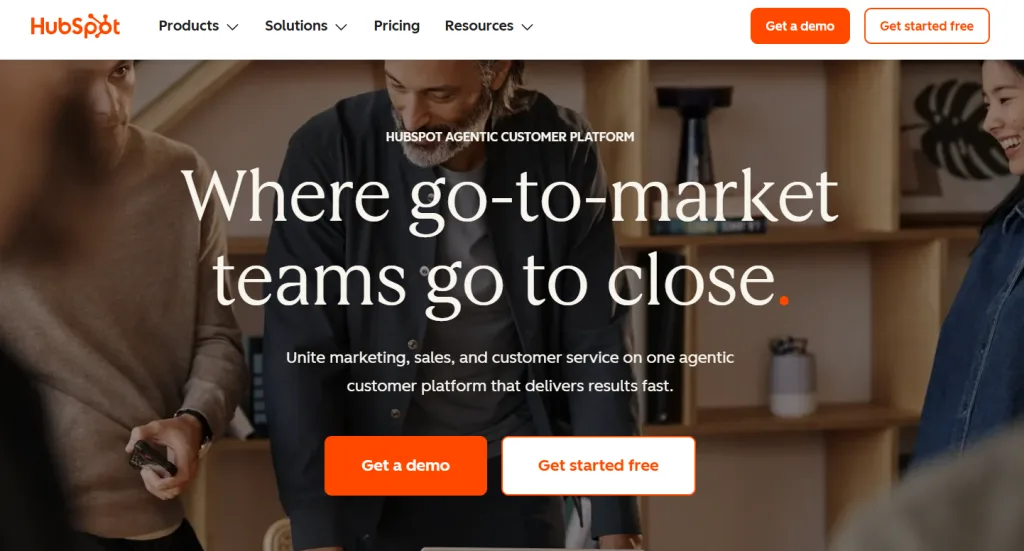
HubSpot is widely recognized as a market leader for inbound marketing, customer service, and sales alignment. Built natively on a single database rather than acquired through fragmented software purchases, HubSpot offers a smooth user experience across scaling organizations.
Key Features
- Multi-touch campaign attribution modelling across web, social, and email channels.
- Visual lead scoring engine combining demographic parameters with behavioural triggers.
- Drag-and-drop landing page, form, and email design tools.
- Comprehensive deal management pipelines with automated task generation.
AI-Enabled Capabilities
HubSpot utilizes its Breeze AI suite to enrich contact records automatically, draft personalized email copy, summarize lengthy deal activity histories, and provide predictive buyer intent alerts.
Plans and Pricing
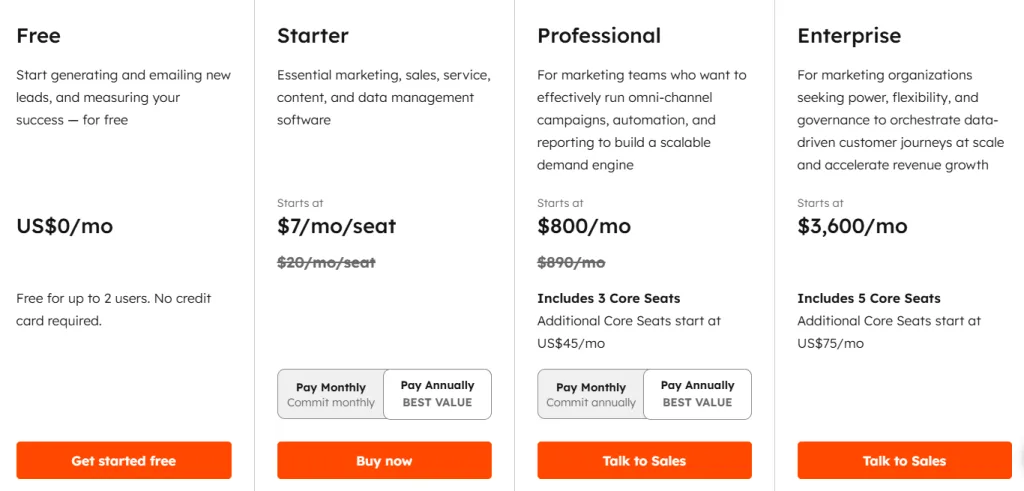
- Free CRM – $0 (Basic contact management, ticketing, and form capture).
- Starter Customer Platform – Starts at ~$7/seat/month.
- Professional Customer Platform – Starts at ~$800/month (Includes Pro hubs, custom automation, and advanced analytics).
- Enterprise Customer Platform – Starts at ~$3,600/month (Enterprise controls, custom objects, advanced reporting).
Review Highlights & Recognition
- G2 Awards – Ranked #1 Best Global Software Company and earned the top position for Sales Hub.
- Industry Standing – Recognized as one of the most trusted brands in marketing automation and sales management for mid-market businesses.
2. Salesforce
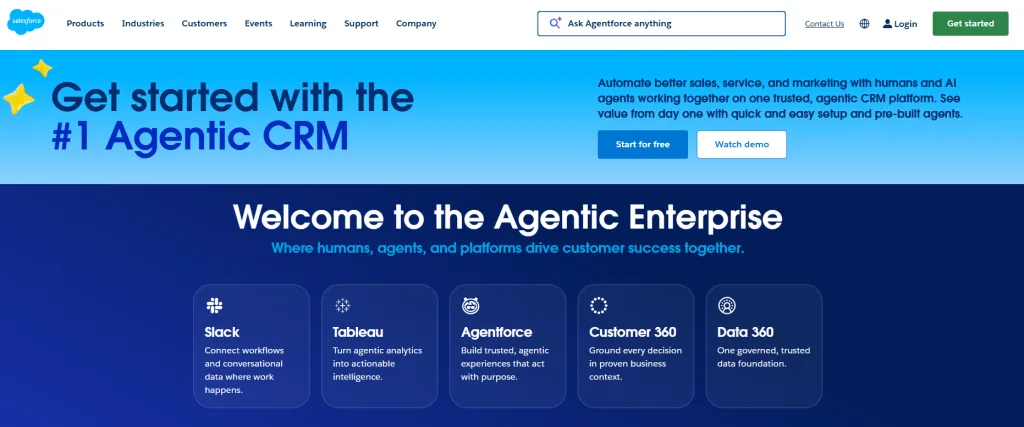
Salesforce Sales Cloud and Marketing Cloud represent the enterprise gold standard for deeply customizable customer relationship management and scalable workflow orchestrations.
Key Features
- Unlimited custom object relationships and tailored architectural layouts.
- Complex multi-stage sales opportunity tracking with AI territory mapping.
- Enterprise Data Cloud integration unifying structured and unstructured enterprise data.
- Deep AppExchange software marketplace with thousands of third-party extensions.
AI-Enabled Capabilities
Salesforce features Agentforce and Einstein AI, providing predictive lead scoring, automated deal health scoring, natural-language conversational analytics, and autonomous AI agents capable of executing multi-step business workflows.
Plans and Pricing
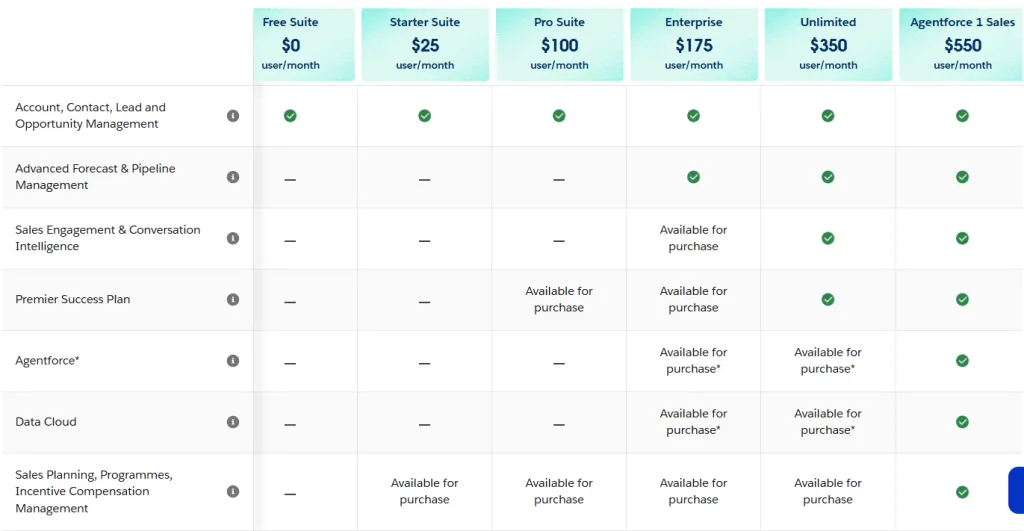
- Starter Suite – ~$25/user/month (Basic sales and service capabilities).
- Professional – ~$100/user/month (Complete pipeline management).
- Enterprise – ~$175/user/month (Complex workflow automation and API access).
- Unlimited – ~$350/user/month (Includes advanced Einstein features and performance support).
- Note – Agentforce features utilize usage-based options, including Flex Credit packages. Starting at $550.
Review Highlights & Recognition
- Gartner Magic Quadrant – Named a Leader in the Gartner Magic Quadrant for Customer Data Platforms.
- Destination CRM – Consistently recognized with Industry Leader Awards for Best Enterprise CRM Suite.
3. ActiveCampaign
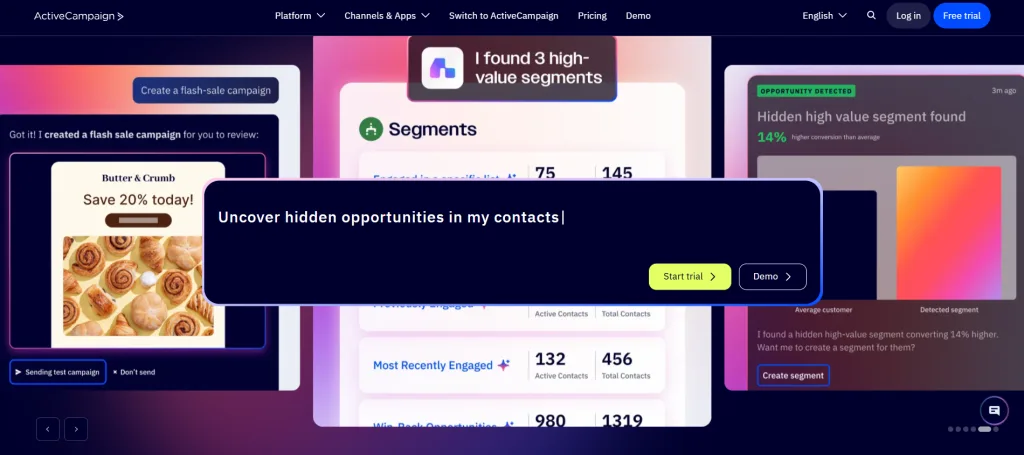
ActiveCampaign specializes in visual, email-driven marketing automation, customer lifecycle orchestration, and behaviour-based contact management.
Key Features
- Industry-leading visual workflow builder supporting multi-branch conditional logic.
- Site tracking that monitors user behaviour on websites to trigger timely outreach.
- Integrated CRM deal pipelines tied directly to email automation actions.
- Machine-learning predictive sending times and dynamic content insertion.
AI-Enabled Capabilities
Incorporate predictive sending optimization, automated message drafting, predictive conversion scoring, and generative campaign builder templates.
Plans and Pricing
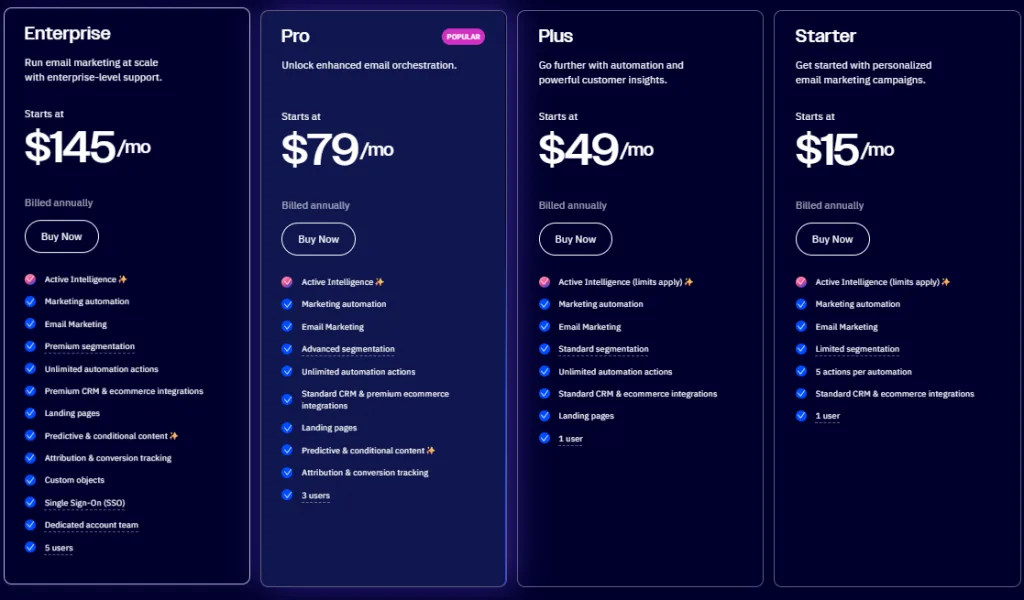
- Starter Plan – Starts at $15/month (for 1,000 contacts, basic automation).
- Plus Plan – Starts at $49/month (Includes landing pages, lead scoring, and CRM features).
- Pro Plan – Starts at $79/month (Includes predictive sending, dynamic content, and attribution).
- Enterprise Plan – Starts at $145/month (Custom reporting, single sign-on, dedicated account support).
Review Highlights & Recognition
- TrustRadius & G2 – Consistently top-rated for automation usability and deliverability performance.
- G2 Best Software Awards – Multi-year winner for Best Marketing Products.
4. Pipedrive
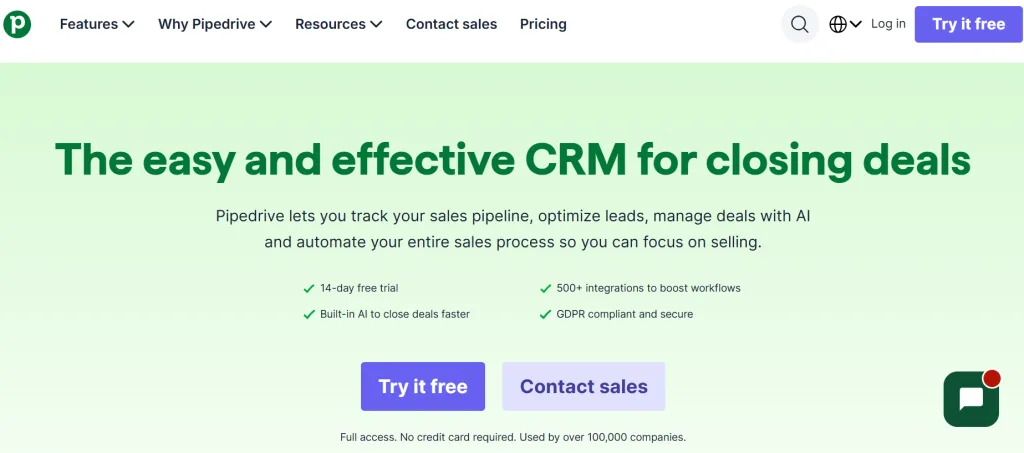
Pipedrive is a sales-first CRM engineered specifically to eliminate administrative friction for deal closers through a clean visual interface design.
Key Features
- Visual, drag-and-drop sales pipeline management.
- Web visitors add-on tracking prospect interactions directly on business sites.
- Built-in email sync with read notifications, templates, and scheduling links.
- Automated activity reminders preventing stale contacts across pipeline stages.
AI-Enabled Capabilities
Features a Sales Assistant AI that analyzes sales performance patterns, calculates win probabilities, and recommends optimal next steps for active accounts.
Plans and Pricing
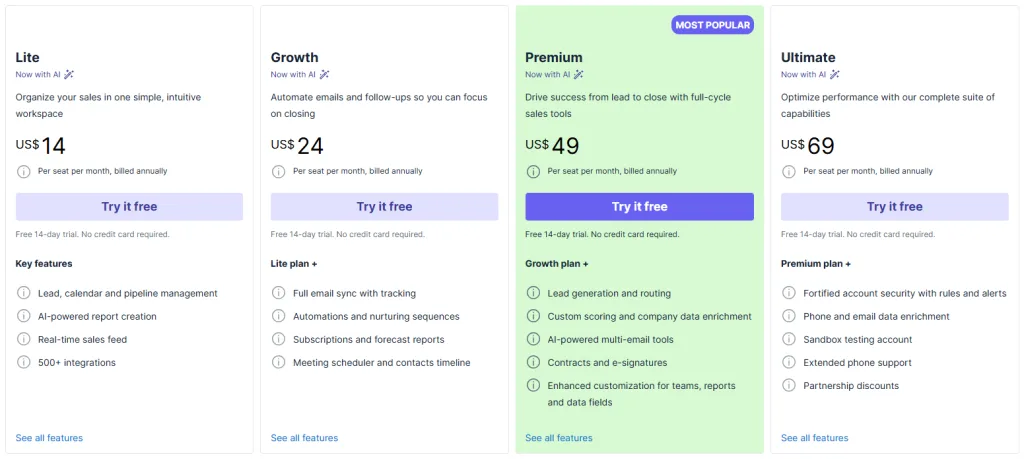
- Lite – ~$14/user/month (Lead and pipeline management).
- Growth – ~$24/user/month (Full email sync and workflow automation).
- Premium – ~$49/user/month (Advanced reporting and revenue forecasting).
- Ultimate – ~$69/user/month (Custom project management and phone support).
Review Highlights & Recognition
- SoftwareReviews – Awarded Gold Medalist in the Lead Management Data Quadrant.
- Capterra & G2 – Frequently ranked as the most user-friendly pipeline management tool for SMB sales reps.
5. Zoho CRM
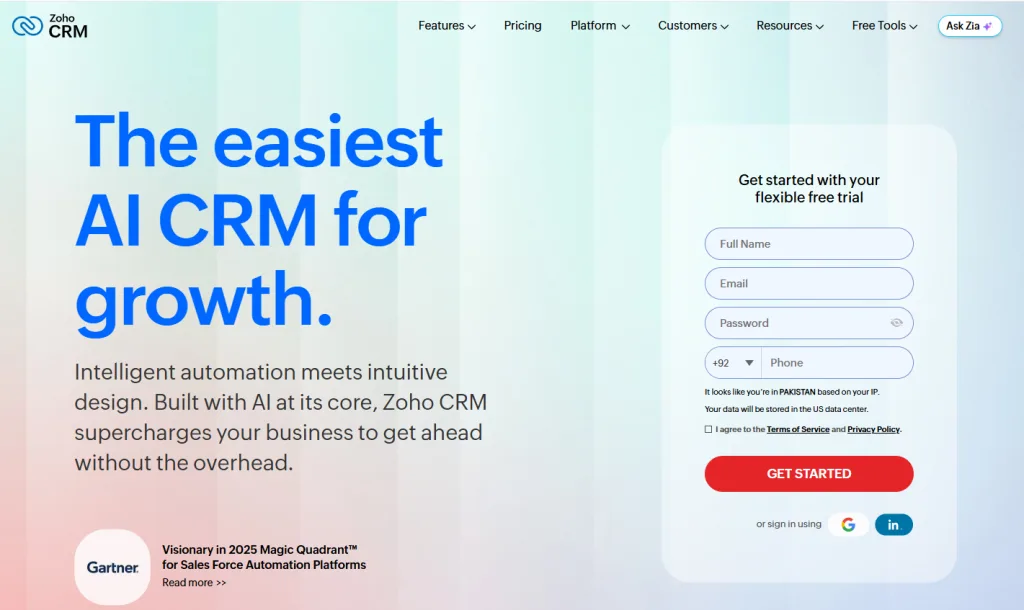
Zoho CRM delivers enterprise-grade customization at an affordable price point, operating seamlessly within the wider 50+ app Zoho business ecosystem.
Key Features
- Process management automation using Canvas design interfaces and Blueprint execution rules.
- Omnichannel communication support (Email, telephony, social media, live chat).
- Advanced workflow rules, webhooks, and custom function triggers.
- Comprehensive inventory and invoice management built into contact profiles.
AI-Enabled Capabilities
Powered by Zia, an AI assistant offering anomaly detection in sales figures, win-rate predictions, sentiment analysis on customer communications, and voice command queries.
Plans and Pricing
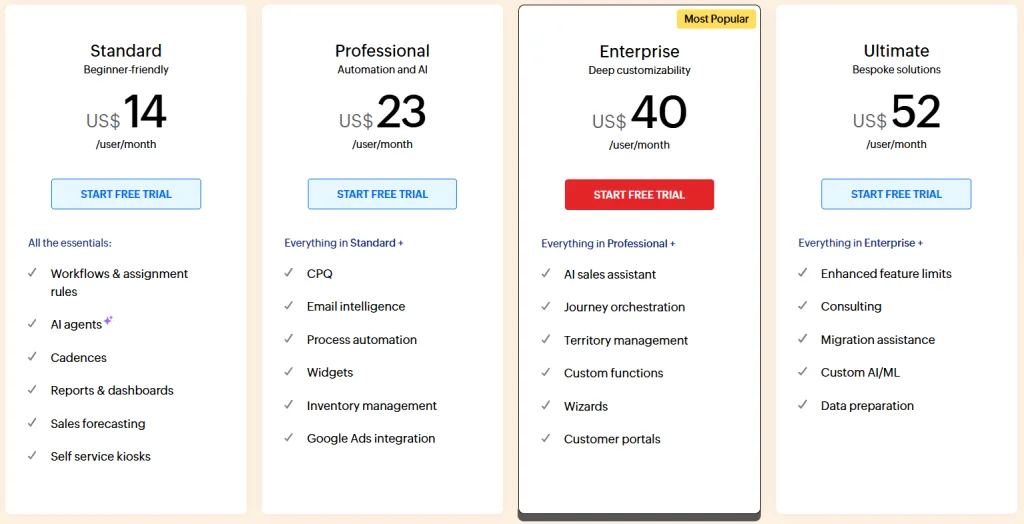
- Standard – ~$14/user/month (Scoring rules and automated workflows).
- Professional – ~$23/user/month (Process builder and inventory management).
- Enterprise – ~$40/user/month (Includes Zia AI, multi-user portals, and Canvas customization).
- Ultimate – ~$52/user/month (Advanced BI analytics and dedicated database capacity).
Review Highlights & Recognition
- Nucleus Research – Named a Technology Leader in Sales Force Automation.
- Destination CRM – Awarded Market Leader status for Small/Midmarket CRM Suites.
6. Klaviyo
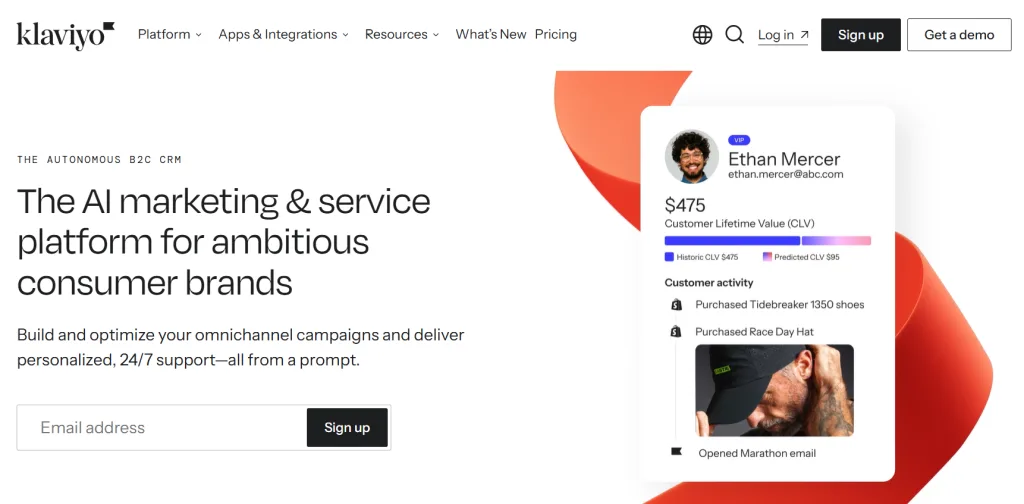
Klaviyo is a data and marketing automation engine built specifically for e-commerce, direct-to-consumer (DTC), and retail brands.
Key Features
- Real-time sync with major e-commerce platforms (Shopify, WooCommerce, Magento, BigCommerce).
- Granular customer segmentation driven by purchase frequency, average order value (AOV), and catalogue views.
- Integrated multi-channel automation spanning Email, SMS, and Mobile Push notifications.
- Predictive analytics calculating churn risk, lifetime customer value, and next purchase dates.
AI-Enabled Capabilities
Offers AI-generated subject lines, dynamic email layouts tailored to user preference, predictive customer analytics, and automated SMS conversation routing.
Plans and Pricing
- Free Plan – $0/month (Up to 250 contacts and 500 email sends).
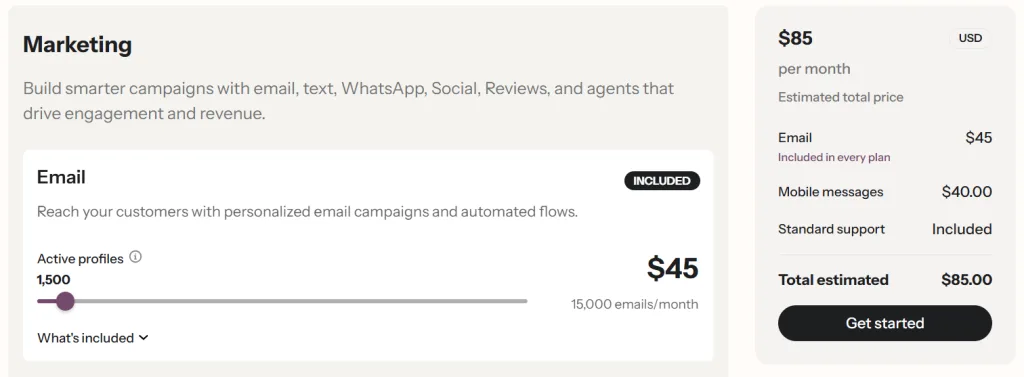
- Email Marketing – Starts at ~$45/month for up to 1500 contacts (Scales dynamically based on total contact volume).
- Email + SMS Plan – Starts at ~$85/month (Includes 2900 SMS credit packages).
Review Highlights & Recognition
- Shopify Commerce Awards – Rated as a premier marketing solution across e-commerce app hubs.
- G2 Grid Leader – Rated #1 in E-Commerce Marketing Automation software rankings.
7. Freshsales
Freshsales (part of the Freshworks suite) pairs contact management with multi-channel sales engagement tools to help teams qualify leads faster.
Key Features
- Built-in cloud phone system, email sync, WhatsApp messaging, and chat widgets.
- Visual pipeline management with stage rot thresholds and deal rotting alerts.
- Automated contact assignment based on geographic territories or rep capacities.
- Territory management with custom sales goals and rep performance leaderboards.
AI-Enabled Capabilities
Employs Freddy AI to analyze contact interaction signals, rank contacts by conversion probability, offer sales sequence suggestions, and generate contact summary profiles.
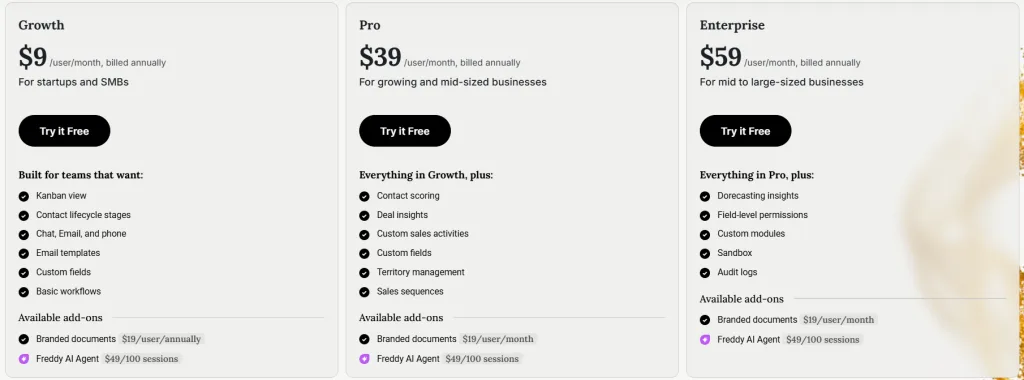
Plans and Pricing
- Free Plan – $0 (Basic contact management and built-in chat/phone).
- Growth – ~$9/user/month (Automated workflows and pipelines).
- Pro – ~$39/user/month (Multiple pipelines, sales sequences, and Freddy AI insights).
- Enterprise – ~$59/user/month (Custom modules, advanced governance, and dedicated account management).
Review Highlights & Recognition
- G2 Leader – Highly scored for rapid setup speed and intuitive UI design.
- Gartner Peer Insights – Recognized as a Customers’ Choice for Sales Force Automation.
8. Brevo
Brevo (formerly Sendinblue) provides budget-friendly messaging, email marketing, and integrated sales CRM tools built around transactional efficiency.
Key Features
- Unified inbox combining email, WhatsApp, Instagram messaging, and live website chat.
- Multi-channel campaign automation including email, transactional SMS, and push channels.
- Clean deal tracking pipelines and appointment scheduling tools.
- Web landing page builders and signup form management.
AI-Enabled Capabilities
Includes AI email subject line generation, automated translation tools, optimized send-time scheduling, and conversational chat triggers.
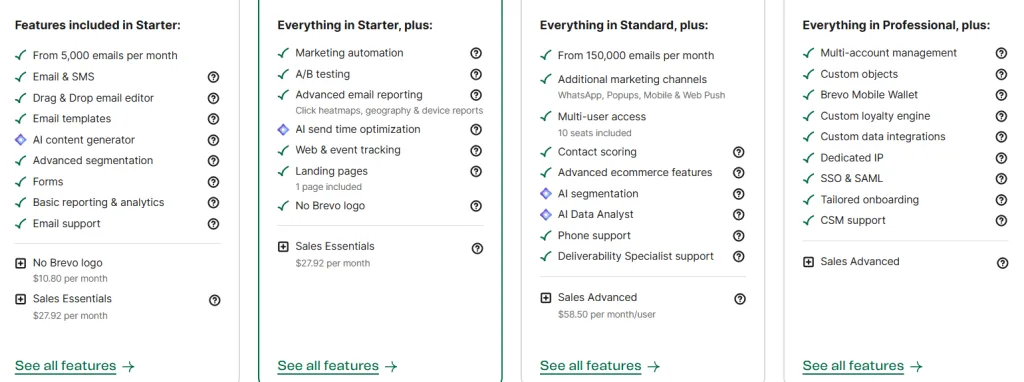
Plans and Pricing
- Free Plan – $0/month (300 emails/day limit, unlimited contact storage).
- Starter – Starts at ~$8/month (No daily send limits, basic analytics).
- Business – Starts at ~$16/month (Marketing automation logic, landing pages, multi-user support).
- Professional – Starts at ~$449/month (Marketing channels, AI segmentation, AI Data Analyst, 150k emails, 10 seats).
- Enterprise – Enterprise custom pricing (Enterprise SLAs, SSO, dedicated account manager).
Review Highlights & Recognition
- Capterra Value Award – Celebrated for low total cost of ownership (TCO) and flexible pricing based on send volume rather than list size.
9. EngageBay
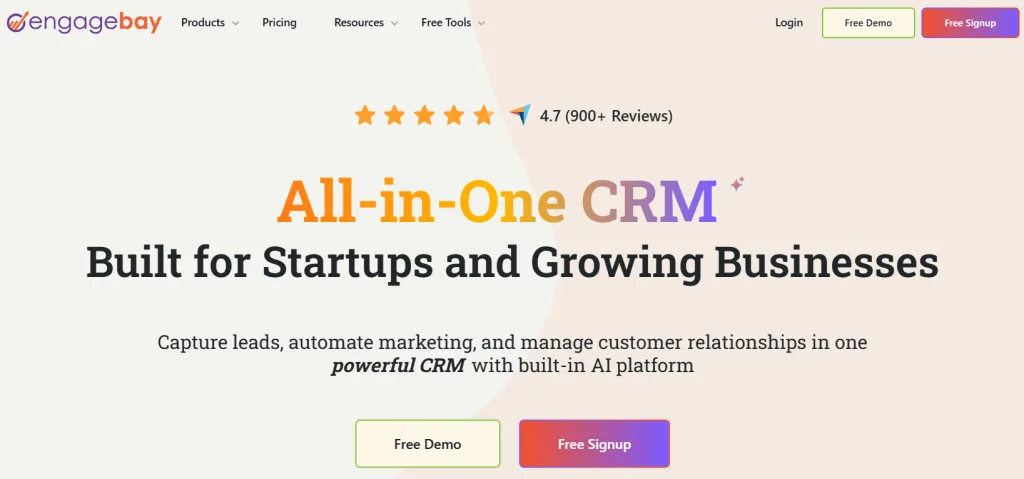
EngageBay delivers an affordable, all-in-one software alternative for small businesses looking to merge marketing, sales pipeline management, and helpdesk support.
Key Features
- All-in-one suite spanning Marketing Hub, Sales Bay, and Service Touchpoints.
- Visual drag-and-drop workflow builders for email sequences and lead segmentation.
- Appointment scheduling software with custom calendar links.
- Built-in helpdesk ticketing and live chat interface.
AI-Enabled Capabilities
Content drafting tools for email creation, auto-responders, subject line generation, and lead sentiment evaluation.
Plans and Pricing
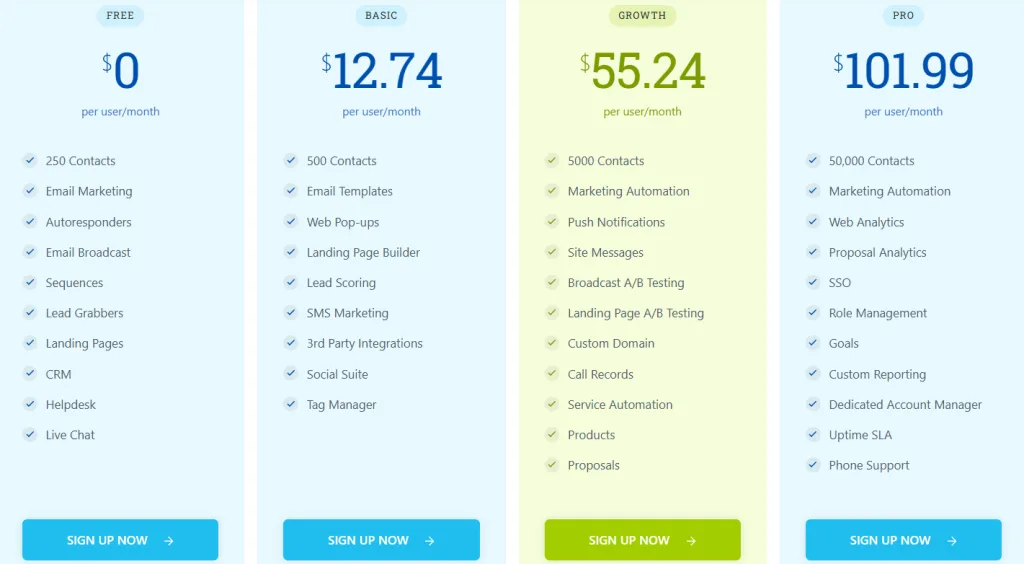
- Free Plan – $0/month (500 contacts, basic CRM and email marketing).
- Basic – ~$12.74/user/month (1,000 contacts, email templates, landing pages).
- Growth – ~$55.24/user/month (10,000 contacts, marketing automation, proposal tools).
- Pro – ~$101.99/user/month (30,000 contacts, dedicated account manager, custom reporting).
Review Highlights & Recognition
- G2 High Performer – Recognized in the All-in-One CRM category for value and customer support quality.
10. Keap
Keap (formerly Infusionsoft) is designed specifically for service-based businesses, local providers, and entrepreneurs needing automated client management, scheduling, and billing.
Key Features
- Integrated client invoicing, payment processing (Stripe/PayPal), and quote management.
- Visual automation builder linking appointments, text alerts, and follow-up emails.
- Built-in dedicated business phone number with automated text replies for missed calls.
- Contact records tracking client notes, estimates, contracts, and payment histories.
AI-Enabled Capabilities
Smart campaign drafting, customer response generation, automated invoice follow-ups, and copy optimization.
Plans and Pricing
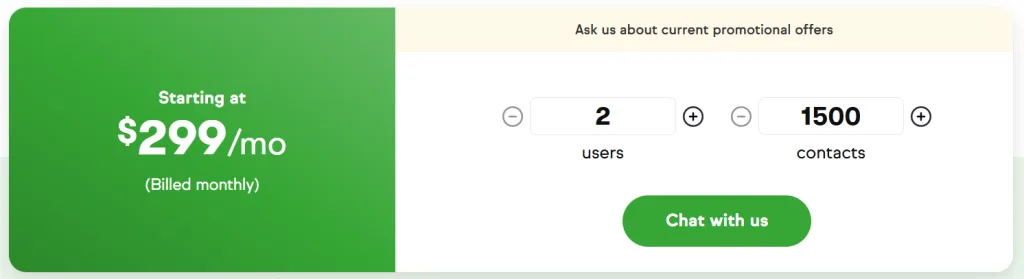
- Pro Plan – Starts at ~$299/month (Includes 1,500 contacts and 2 users).
- Ultimate Plan – Starts at ~$413/month (Includes 2,500 contacts, advanced analytics, custom affiliate tracking, and lead scoring).
Review Highlights & Recognition
- PCMag Editors’ Choice – Recommended for small service businesses seeking integrated quote-to-invoice automation.
How to Use CRM Tools Across Different Segments
Deploying CRM Tools effectively requires tailoring implementation workflows to your organization’s specific business model.
1. B2B Enterprise & High-Ticket Sales
In high-ticket B2B environments, sales cycles take months and involve multiple decision-makers.
- Account-Based Marketing (ABM) – Group individual contacts under master company profiles. Track collective engagement across stakeholders.
- Multi-Stage Lead Scoring – Combine explicit data (job title, revenue size) with implicit activity (whitepaper downloads, pricing page visits) to auto-assign accounts when scoring passes defined threshold limits.
2. B2C & E-Commerce Brands
E-commerce businesses process large transaction volumes requiring hyper-personalized, automated customer flows.
- RFM Segmentation – Segment customers based on Recency, Frequency, and Monetary transaction value to send targeted retention campaigns.
- Behavioural Triggers – Automatically dispatch multi-channel recovery sequences (Email + SMS) within 15 minutes of abandoned shopping carts.
3. Service-Based & Local Operations
Local agencies, contractors, and professional service firms win on speed-to-lead and seamless administrative processes.
- Automated Lead Intake – Instantly reply to web form submissions via text message with scheduling links before prospects call competitors.
- Quote-to-Invoice Workflows – Automatically generate digital agreements and invoice payment links once a deal stage updates to “Accepted.”
AI-Enabled Options and Specialized Alternatives
Beyond the core market leaders, specialized marketing automation solutions provide targeted capabilities for specific enterprise architectures. Marketo, for example, is a well-known enterprise marketing automation option for organizations that need sophisticated campaign orchestration, account-based marketing, and lead management. The wider category also includes platforms focused on customer engagement, e-commerce, email marketing, and mobile messaging.
- Pega Customer Decision Hub – Leverages real-time AI decisioning to evaluate context and determine the optimal next action during active customer interactions.
- SendPulse – Blends email automation with web push notifications, transactional SMS, and AI chatbots across WhatsApp and Telegram.
- User.com – Integrates real-time visitor tracking, live chat support, email automation, and call management into a unified database.
- Insider One – A cross-channel customer experience platform using predictive AI algorithms to personalize web, app, and messaging journeys for global brands.
- Adobe Experience Cloud – Designed for enterprise setups, connecting deep customer analytics with automated content orchestration.
- Braze – Specialized customer engagement platform built for mobile-first brand applications, real-time event messaging, and dynamic push notifications.
- Iterable – Delivers omni-channel customer engagement by organizing dynamic, event-driven communication flows across email, mobile, and web channels.
- Mailchimp – An accessible marketing suite providing user-friendly email creation, landing page generation, and light sales contact tracking for startups.
- Omnisend – A purpose-built email and SMS marketing automation platform designed specifically for fast-growing e-commerce stores on Shopify and BigCommerce.
Your Digital Growth Partner
The Secret Behind Predictable, Scalable Growth!
When your sales and marketing speak the same language, lead leakage disappears, pipelines move faster, and every customer interaction turns into lasting enterprise value.

Real-World Case Study – Transforming Growth Pipelines
To see how modern technology drives measurable business impact, consider a B2B SaaS platform that migrated from disconnected software tools to an integrated architecture built around CRM & Marketing Automation Tools.
The Challenge
A fast-growing enterprise software provider was suffering from a leaky sales funnel:
- Inbound leads sat in email inboxes for an average of 14 hours before receiving outreach.
- Sales representatives had no visibility into web pages visited or content consumed by prospects prior to scheduling demo calls.
- Marketing teams ran general blast campaigns to the entire email database, resulting in high unsubscribe rates and low email engagement.
The Solution
The enterprise deployed a unified setup combining automated lead management with real-time sales tracking:
- Instant Form Capture & Routing – Inbound form fills immediately triggered automated qualification emails with calendar booking links. If unbooked within 2 hours, the lead was automatically assigned to an available sales rep based on territory rules.
- Behavioural Lead Scoring – Leads accrued points when reviewing pricing pages or downloading technical whitepapers. Reaching 75 points instantly notified reps via Slack with engagement history attached.
- Automated Lifecycle Nurturing – Unqualified prospects were routed into vertical-specific drip campaigns, while active deal stages automatically suppressed marketing promotions.
The Results
Within six months of deploying these automated workflows:
- Speed-to-Lead Improvement – Average response time dropped from 14 hours to 4 minutes.
- Pipeline Velocity – Conversion rates from qualified lead to demo scheduled increased by 38%.
- Cost Efficiency – Customer acquisition cost (CAC) fell by 28% due to higher close rates and shorter sales cycles.
How to Choose the Right Software Strategy
Marketing automation software should be selected by balancing feature depth, implementation complexity, CRM compatibility, and ongoing software expenses. Selecting the right marketing automation platform requires balancing feature depth, implementation complexity, CRM compatibility, and ongoing software expenses.
A useful evaluation should consider whether A Marketing automation platform can centralize customer data, support customer segmentation, automate repetitive workflows, and provide reliable conversion tracking across the customer journey. The best marketing automation software is not necessarily the platform with the longest feature list; it is the system that aligns with the organization’s processes, team capabilities, and growth model.
Selecting the right system requires balancing feature depth, implementation complexity, and ongoing software expenses. Use this step-by-step decision framework:
- Audit Technical Readiness & Budget – Factor in non-software expenses including onboarding setup fees, admin training, custom API configurations, and tier-based contact overages.
- Prioritize Team Adoption – The best platform is the one your sales reps and marketing managers actually log into daily. Complicated user interfaces increase data entry friction and degrade reporting accuracy.
- Verify Third-Party Connectivity – Ensure your software choice offers robust native connectors or open REST APIs for critical tools like your ERP, accounting system, support platform, and custom databases.
- Test Scalability Horizons – Choose software flexible enough to support double or triple your current contact volumes and account seats without requiring a full software migration within 24 months.
Marketing Automation for Canadian Businesses
For Canadian businesses, platform selection should also reflect the realities of the Canadian market. Teams serving multiple provinces, customer segments, or sales territories can benefit from marketing automation tools that support granular customer segmentation, localized customer journeys, compliant data practices, and coordinated email marketing.
A marketing automation platform can connect digital marketing campaigns with CRM records so teams can understand which channels generate qualified leads and which workflows improve customer retention.
When comparing marketing automation platforms, Canadian organizations should assess integrations, data governance, reporting, scalability, and the ability to personalize communications without creating disconnected customer experiences. Marketing automation tools for businesses are most effective when they become part of a broader MarTech strategy rather than another isolated application.
Conclusion
Adopting modern CRM & Marketing Automation Tools is one of the highest-leverage operational investments a business can make. By unifying lead attraction, behavioural tracking, automated follow-ups, and pipeline tracking, organizations build scalable engines that turn anonymous website visitors into loyal accounts.
Whether you choose an all-in-one platform like HubSpot or Zoho CRM, an enterprise ecosystem like Salesforce, or specialized Marketing Automation Tools like ActiveCampaign or Klaviyo, focus on operational execution – build clean data structures, streamline lead handoffs, and continuously refine automated messaging based on real buyer behaviour.
Partner With Potens Digital
Ready to modernize your marketing infrastructure, build high-converting automation workflows, and scale your growth architecture? Contact Potens Digital today to schedule a consultation with our system implementation experts.
Your Digital Growth Partner
Turn Disconnected Tools Into Your Growth Engine
Stop letting qualified leads slip through system gaps. Partner with Potens Digital to build a unified, automated CRM infrastructure that optimizes your conversion funnel, lowers acquisition costs, and scales revenue predictably.

