

Proven tactics to boost local visibility and drive predictable clinic appointment growth.
Running a successful physiotherapy clinic in Canada requires more than world-class clinical expertise, manual therapy skills, and patient care. To keep your appointment books filled month after month, your clinic must be visible precisely when patients experience pain, suffer a sports injury, or search for rehabilitation services online.
Implementing a targeted strategy for physiotherapist SEO turns search engines like Google into a predictable, high-converting pipeline for direct patient inquiries. Whether you run a single-location private practice, a multi-disciplinary sports clinic, or a mobile physiotherapy business, mastering search engine optimization ensures that prospective patients find your practice before they ever discover your local competitors.
Key Takeaways for Canadian Clinic Owners
If you need a quick overview of what drives real search visibility and clinical growth, here are the essential components of an effective SEO strategy for physiotherapists:
- Dominate Local Google Maps – Over 46% of all Google searches carry local intent. Optimizing your Google Business Profile (GBP) is the single fastest way to secure high-converting local map pack rankings.
- Build Dedicated Service Pages – Create individual, deep-dive landing pages for every treatment modality you offer (e.g., pelvic floor therapy, dry needling, vestibular rehab) rather than clumping services onto a single page.
- Target High-Intent Condition Keywords – Patients rarely search for generic terms first. They type specific queries like “sciatica pain treatment in Toronto” or “rotator cuff physical therapy near me.”
- Enforce Strict E-E-A-T & Healthcare Compliance – Health-related search queries fall under Google’s “Your Money or Your Life” (YMYL) guidelines. Demonstrating authoritativeness, medical accuracy, and practitioner credentials is non-negotiable.
- Optimize for Speed and Mobile Experience – More than 70% of healthcare searches occur on mobile devices. Fast load times and easy online booking buttons directly impact conversion rates.
- Cultivate Patient Reviews & Local Citations – Consistent, high-volume Google reviews paired with accurate Name, Address, and Phone number (NAP) listings across Canadian business directories build immediate trust with both algorithms and patients.
Canadian Physiotherapy Market Insights & Search Trends
The Canadian physical therapy and rehabilitation landscape is experiencing unprecedented growth, fueled by an aging population, rising athletic participation, and an increased preference for non-invasive musculoskeletal care.
Data from Statistics Canada and healthcare research indicate that musculoskeletal conditions account for one of the highest volumes of primary care consultations across the country. According to research published in the Journal of Medical Internet Research, over 83% of health consumers turn to online search engines as their first step in evaluating care options, diagnosing discomfort, and selecting a healthcare provider.
Furthermore, Canadian patient behaviour shows a strong preference for localized, accessible care:
- High Commercial Intent – Searches containing geographic modifiers (e.g., “Vancouver physio clinic”, “Calgary sports rehabilitation”) convert at a rate 3x higher than non-local informational queries.
- High Lifetime Value (LTV) – A single physiotherapy patient who completes an initial assessment and a full 6-to-10-session plan of care represents $800 to $1,800+ in clinic revenue. Securing just 5 to 10 additional organic patient bookings per month significantly increases annual revenue.
Working with an experienced physiotherapy digital marketing agency in Canada allows Canadian clinics to capture this high-intent search traffic and outpace local competition across provinces and municipalities.
What Is SEO for Physiotherapy Clinics?
SEO for physiotherapy clinics is the specialized practice of optimizing your clinic’s website, online profiles, local listings, and digital content so that search engines rank your practice at the top of organic search results for relevant patient queries.
Unlike traditional advertising, which interrupts prospective patients, physiotherapist SEO marketing positions your clinic directly in front of individuals who are actively seeking immediate pain relief, post-surgical rehabilitation, or athletic performance recovery.
A comprehensive search engine strategy spans four main pillars:
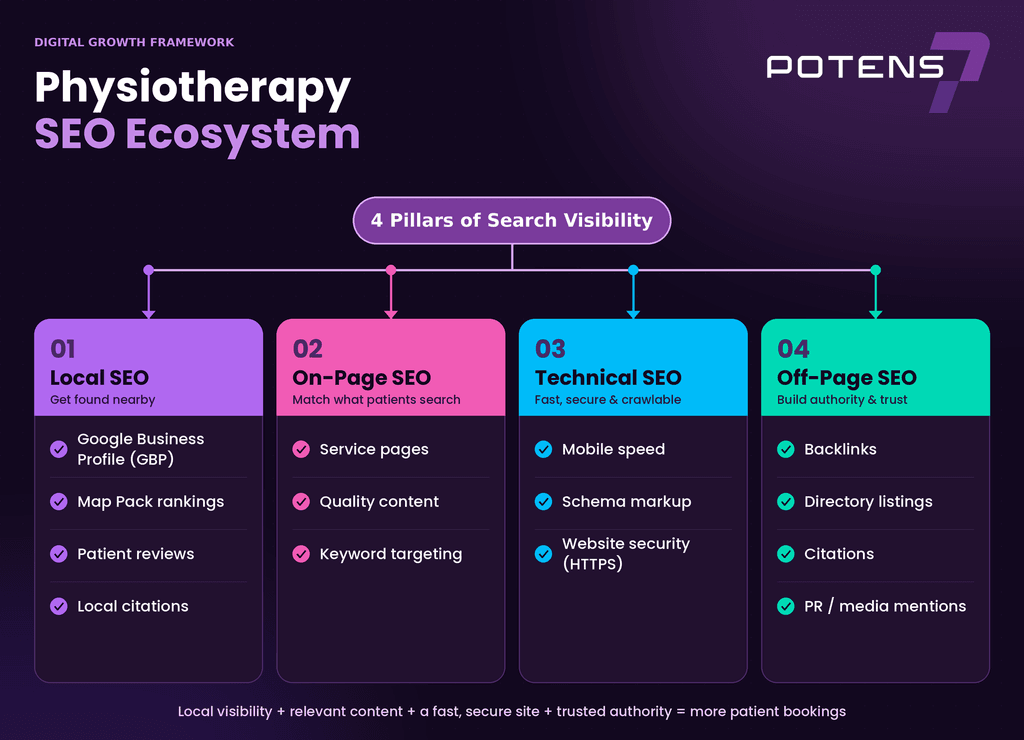
- Local SEO – Securing top positions in Google’s Map Pack and localized search results for city-specific keywords.
- On-Page SEO – Creating high-quality, condition-focused service pages optimized with strategic heading structures, metadata, and medical authority.
- Technical SEO – Ensuring your website loads fast, is fully mobile-responsive, secure (HTTPS), and easily crawlable by search engine bots.
- Off-Page SEO – Building digital authority through local healthcare directory citations, community partnerships, high-quality backlinks, and positive patient reviews.
Partnering with a specialized physiotherapist SEO agency ensures every component is structured according to Google’s strict search algorithms and healthcare content guidelines.
Why SEO Is Essential for Modern Physiotherapy Practices
Many clinic owners rely heavily on word-of-mouth referrals from general practitioners or past patients. While referrals remain valuable, digital search trends show that relying solely on offline referrals leaves massive revenue on the table.
Here is why investing in SEO for physiotherapy businesses yields long-term returns:
1. High-Intent Patient Acquisition
When someone searches for “emergency sports physio clinic in Edmonton,” they are not passively browsing; they are experiencing acute pain or functional limitation and require care immediately. Ranking prominently for these terms places your practice at the precise moment of intent.
2. Compounding Return on Investment (ROI)
Unlike paid advertising platforms, where traffic halts the second you pause your ad budget, SEO for physiotherapy practices creates lasting digital real estate. High-ranking service pages and helpful educational content continue to attract qualified organic traffic month after month without incremental ad costs.
3. Lower Cost Per Acquisition (CPA)
By building consistent organic rankings through tailored physiotherapy SEO services, practices can reduce their reliance on expensive pay-per-click ad campaigns, driving down the overall cost to acquire each new patient.
4. Long-Term Brand Authority
Appearing at the top of search results establishes immediate clinical trust. Prospective patients perceive top-ranked clinics as established, trustworthy market leaders across their local community.
To build a complete growth engine, practices often integrate search strategies with robust digital marketing services to establish brand presence across all digital touchpoints.
Keyword Research Strategies for Physiotherapists
Effective physiotherapy clinic SEO begins with comprehensive, intent-driven keyword research. You must identify exactly how prospective patients describe their pain, conditions, and treatment goals when searching online.
Intent Categorization Matrix for Physiotherapy Keywords
| Keyword Category | Patient Search Intent | Example Search Phrases | Search Volume & Conversion Potential |
| Transactional / Local | High intent; immediate booking desire | “physiotherapist near me”, “best physio clinic Calgary”, “physiotherapy practice SEO” | High Conversion / High Competition |
| Service-Specific | High intent; seeking specialized modalities | “pelvic floor physiotherapy Vancouver”, “dry needling rehab Toronto”, “vestibular therapy clinic” | Very High Conversion / Moderate Competition |
| Condition-Based | Moderate-to-high intent; seeking relief solutions | “sciatica exercises physio”, “rotator cuff rehab physical therapy”, “herniated disc physiotherapy treatment” | High Conversion / Low-to-Moderate Competition |
| Informational | Top-of-funnel research; learning about symptoms | “why does my lower back hurt when sitting”, “physio vs chiro for neck pain” | High Volume / Low Direct Conversion |
Executing Targeted Keyword Research
When executing physiotherapist SEO keyword research, balance broad commercial queries with long-tail condition-based phrases:
- Map Core Services – List every service offering provided at your clinic: shockwave therapy, IMS/dry needling, spinal decompression, active rehab, or concussion management.
- Append Geographic Modifiers – Combine core service phrases with your primary city, neighbourhoods, and surrounding suburban regions (e.g., “concussion clinic Mississauga”, “physio North Vancouver”).
- Target Condition Queries – Use keyword tools like Ahrefs, Semrush, or Google Keyword Planner to find question-based queries regarding musculoskeletal pain.
- Analyze Search Engine Result Pages (SERPs) – Inspect the top-ranking pages for target terms to verify whether Google favours dedicated service pages, educational blog guides, or map listings for that phrase.
Using professional search engine optimization services helps identify untapped keyword opportunities in your local market while preventing keyword cannibalization across your site structure.
Optimizing Your Google Business Profile (GBP) for Local Map Pack Rankings
For local healthcare practices, Google Business Profile (formerly Google My Business) is your most valuable organic patient acquisition tool. The top three local listings displayed under the Google Map, known as the “Local 3-Pack”, capture over 40% of all clicks for local search queries.
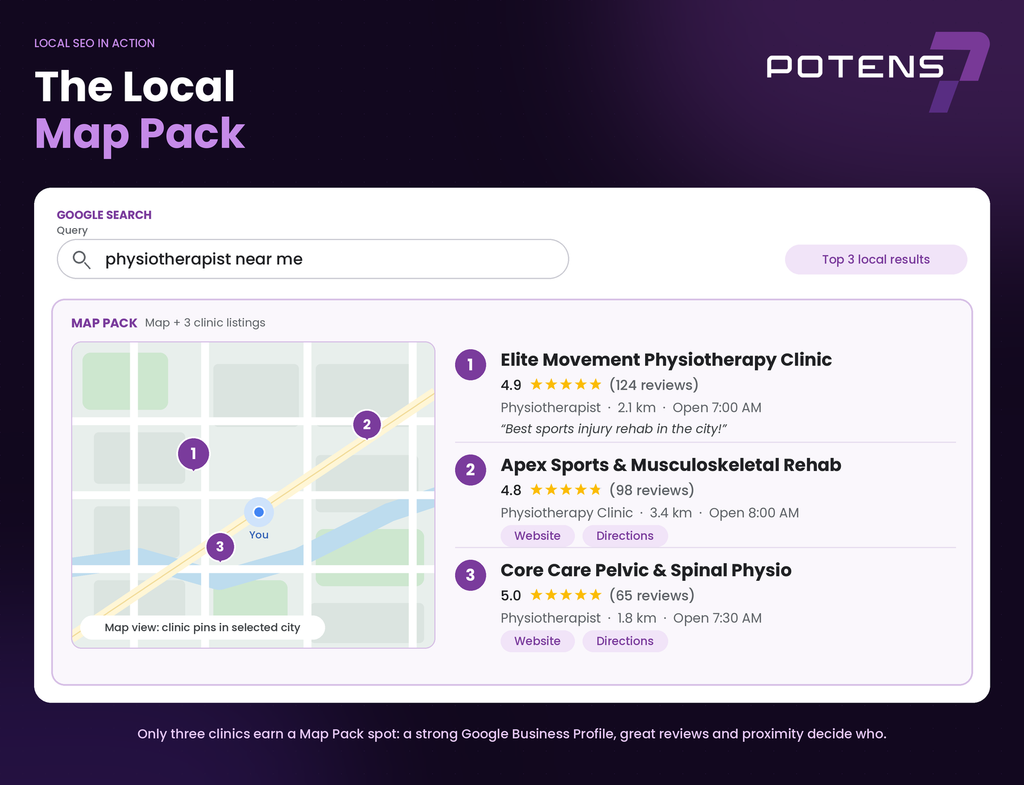
Essential Steps to Fully Optimize Your GBP
- Claim and Verify Ownership – Ensure your clinic claims its official listing on Google Business Profile. If you have multiple locations, maintain separate verified listings for each physical address.
- Select Proper Primary and Secondary Categories:
- Primary Category – Select Physical Therapy Clinic or Physiotherapist.
- Secondary Categories – Add relevant qualifiers like Sports Medicine Clinic, Rehabilitation Center, Acupuncturist, or Wellness Center.
- Ensure Identical NAP Data – Your Business Name, Physical Address, and Phone Number listed on GBP must match your website footprint and external business listings down to the suite number.
- Write an Engaging Business Description – Incorporate target keywords naturally into your 750-character business summary. Highlight your clinical expertise, modalities, parking convenience, and patient-centred care.
- Add High-Quality Visuals – Upload professional high-resolution photos of your clinic entrance, reception area, treatment rooms, specialized equipment, and staff members. Profiles containing authentic photos receive 35% more clicks through to their site than those with stock photography.
- Publish Regular Google Updates – Treat your profile like a localized communication channel. Publish weekly posts featuring health tips, clinic updates, practitioner introductions, and links to fresh blog posts.
For practices seeking aggressive local market dominance, engaging a reputable physiotherapist SEO company ensures ongoing map pack optimization, profile management, and competitor tracking.
On-Page SEO for Physiotherapy Websites
On-page SEO involves optimizing individual webpages so search engines understand their context, relevance, and value. Implementing robust on-page optimization establishes a firm foundation for physiotherapy practice SEO.
| Ideal Service Page Heading Hierarchy | |||
| HTML Tag | Heading Level | Purpose / Function | Example Text |
| <h1> | Primary Title | Page topic featuring primary target service and city | “Sports Injury Physiotherapy in Calgary, AB” |
| <h2> | Section Header | Core topic section 1 – Conditions treated | “What Conditions We Treat” |
| <h3> | Subsection Header | Specific condition subtopic 1.1 | “Ligament Sprains & Muscle Strains” |
| <h3> | Subsection Header | Specific condition subtopic 1.2 | “Post-Surgical Rehabilitation” |
| <h2> | Section Header | Core topic section 2 – Clinical approach | “Our Specialized Treatment Approach” |
| <h3> | Subsection Header | Specific treatment modality 2.1 | “Manual Therapy & Joint Mobilization” |
| <h3> | Subsection Header | Specific treatment modality 2.2 | “Exercise Prescription & Active Rehab” |
| <h2> | Section Header | FAQ section with structured Schema potential | “Frequently Asked Questions” |
| <h2> | Call to Action | Primary conversion & appointment booking block | “Book Your Initial Assessment Today” |
On-Page Optimization Elements
- URL Structure – Keep URLs short, clean, and descriptive.
- Good – yourclinic.ca/services/sports-physiotherapy-calgary
- Bad – yourclinic.ca/page-id=49281
- Title Tags – Place primary keywords near the beginning of title tags while staying under 60 characters.
- Example – Physiotherapist in Toronto | Sports & Rehab Clinic | Potens Digital
- Meta Descriptions – Write compelling, click-worthy meta descriptions (under 160 characters) featuring call-to-actions.
- Example – Recover faster with evidence-based physiotherapy in Toronto. Direct billing available. Book your initial assessment online today!
- Header Tag Structure (H1, H2, H3) – Maintain a clear hierarchy. Use a single H1 tag containing the core page keyword, followed by logically nested H2 and H3 tags for specific subtopics.
- Internal Text Links – Interlink core pages using contextually relevant anchor text to distribute page authority throughout your site.
Building High-Converting Service and Local Landing Pages
One of the most frequent mistakes made by healthcare practices is listing all clinical offerings on a single “Services” page. To rank for competitive search terms, build dedicated, comprehensive landing pages for every individual service and geographic region served.
Anatomy of a High-Ranking Physiotherapy Service Page
| Page Component | Core Elements | Primary Purpose & UX / SEO Function |
| Header Navigation | Logo, Phone Number, Direct Billing Badge, “Book Now” CTA Button | Provides immediate conversion triggers and trust signals right at the top of the page. |
| Hero Section | Clear H1 Heading, High-Quality Visual / Photo, Immediate Booking Form | Captures attention, reinforces local search relevance, and enables instant appointment scheduling. |
| Section 1 – Treatment Overview | Modality Explanation, Clinical Intent, Health Authority Content | Satisfies Google’s E-E-A-T criteria by explaining the science and benefits of the therapy. |
| Section 2 – Conditions Treated | Scannable Bulleted List, High-Intent Keywords | Helps patients quickly identify their pain points while targeting long-tail condition terms. |
| Section 3 – Initial Assessment | Step-by-Step Patient Journey, What to Expect | Alleviates patient anxiety, answers operational questions, and prepares them for their visit. |
| Section 4 – Practitioner Bio | Licensed Physiotherapist Details, Photo, Credentials & College Registration | Establishes medical credibility, practitioner authority, and personal trust. |
| Section 5 – Social Proof | Embedded Google/Video Reviews, Patient Testimonials, Before & Afters | Builds instant local social proof and boosts conversion rates for first-time visitors. |
| Section 6 – FAQ Block | Collapsible Accordion Q&As, FAQPage Schema Markup | Targets long-tail search queries and unlocks rich FAQ snippet listings in Google SERPs. |
| Footer Section | Interactive Google Map, Physical Address (NAP), Hours, Contact Info | Reinforces local SEO signals, NAP consistency, and geo-relevance for Google Maps. |
Local Landing Pages for Multi-Location or Regional Clinics
If your practice serves multiple cities or neighbouring suburbs (e.g., Mississauga, Brampton, and Oakville), build dedicated local landing pages for each municipality.
Avoid duplicating content across these pages. Customize each local landing page with unique location descriptions, specific transit/parking details, local practitioner bios, embedded Google Maps, and distinct patient testimonials.
Executing these landing page architectures requires technical expertise. Partnering with a specialized physiotherapy marketing agency guarantees that page structures meet both search engine standards and user experience expectations.

Your Digital Growth Partner
Dominate Local Google Map Packs in 90 Days
Outranking nearby competitors requires more than basic citations. Discover how our proven local search framework drives top-three Map Pack rankings and automated Google reviews for multi-specialty clinics.

Technical SEO – Ensuring Speed, Mobile Health, and Security
Technical SEO ensures search engines can crawl, index, and evaluate your website without encountering performance barriers.
Key Technical Pillars for Healthcare Sites
- Mobile-First Responsive Design – Over two-thirds of physical therapy searches originate on smartphones. Ensure your site automatically adapts to all screen sizes, featuring large touch-friendly buttons and easy navigation.
- Page Load Speed Optimization – Slow websites increase bounce rates and harm rankings. Optimize performance by compressing images, leveraging browser caching, minifying CSS/JavaScript files, and hosting on fast Canadian servers. Target a Google PageSpeed Insights score of 85+ on mobile.
- HTTPS and SSL Encryption – Patient data security is paramount. Secure your website with SSL encryption (https://). This is an essential trust signal for search engines and patient privacy.
- Fixing Crawl Errors & Broken Links – Regularly audit your site using tools like Screaming Frog or Google Search Console to fix 404 errors, broken internal links, or improper redirect chains.
E-E-A-T for Physiotherapy Websites – Demonstrating Health Authority
Google evaluates health and medical websites under strict Your Money or Your Life (YMYL) criteria. Because healthcare advice directly impacts physical well-being, Google demands exceptionally high levels of E-E-A-T (Experience, Expertise, Authoritativeness, and Trustworthiness).
Practical Strategies to Demonstrate Medical E-E-A-T
- Pertaining to Author Profiles – Publish detailed author bios for every blog article and service guide written by your clinicians. Include their formal credentials (e.g., PT, MPT, FCAMPT), university education, regulatory college registration numbers, and clinical specialties.
- Medical Review Sign-Offs – If content is written or drafted by a content strategist, ensure a licensed physical therapist reviews and approves the clinical details. Add a clear disclaimer – “Medically Reviewed by [Practitioner Name], Registered Physiotherapist on [Date].”
- Citing Peer-Reviewed Research – Support clinical claims regarding rehab timelines, exercise efficacy, or treatment outcomes by referencing peer-reviewed medical journals such as the British Journal of Sports Medicine (BJSM) or the Journal of Orthopedic & Sports Physical Therapy (JOSPT).
Executing high-level health publishing requires adherence to professional standards. Working with a dedicated physiotherapy digital marketing provider helps structure content workflows that align seamlessly with medical E-E-A-T requirements.
Schema Markup for Physiotherapy Practices
Schema markup (structured data) is code added to your site that helps search engines understand your business details, treatments, and author credentials. It also unlocks rich snippets in search results.
Example JSON-LD Schema Code for a Physiotherapy Practice
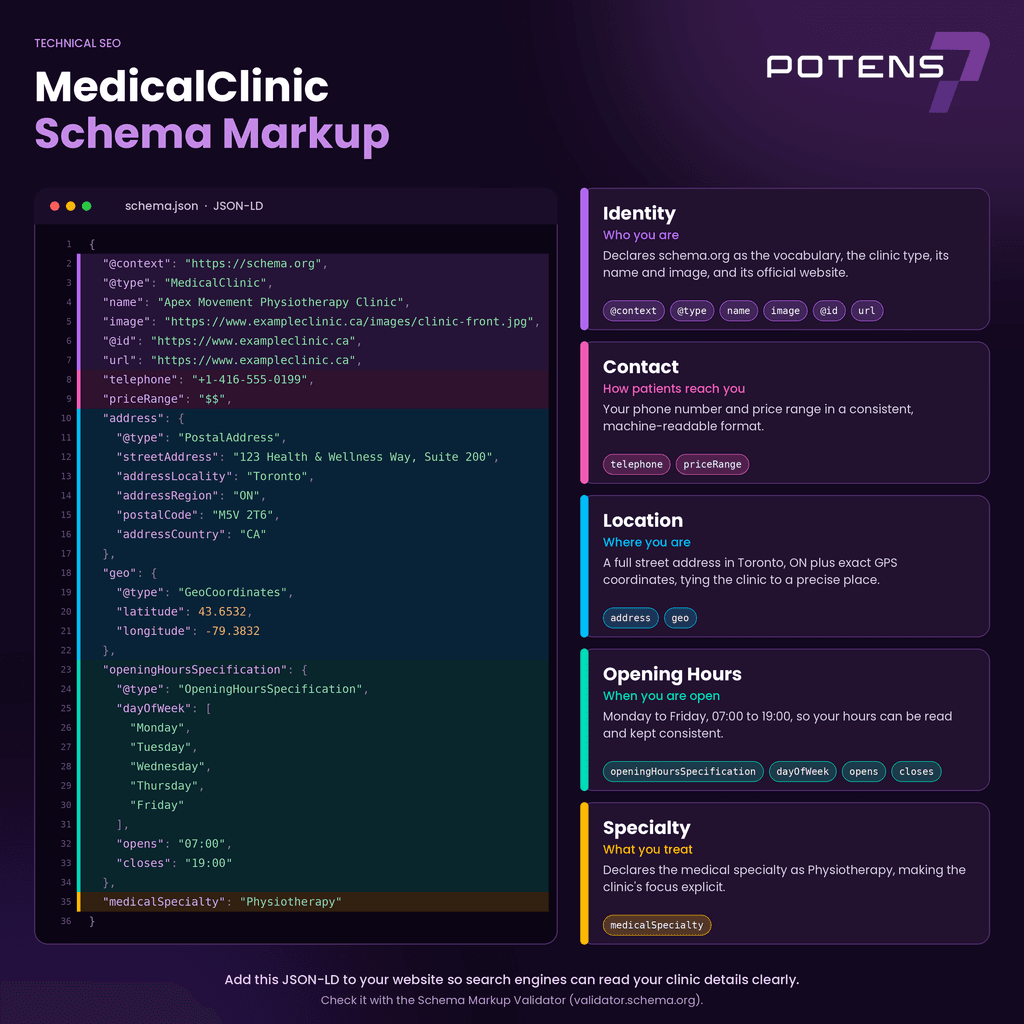
Implementing structured data elevates your search engine listings, increasing click-through rates from prospective patients.
Your Digital Growth Partner
Turn Complex Medical Schema Into Patient Bookings
Generic SEO tactics leave local clinics invisible. We build structured, entity-optimized search architectures that position your practice directly in front of active local patients when intent is highest.

Review & Reputation Management Strategies
Online reviews are a top ranking factor for local map packs and the single most influential conversion metric for prospective patients evaluating physical therapy providers.
Reputation Management Automation Loop
| Stage | Step Name | Trigger / System Action | Purpose & Best Practices |
| 1 | Session Completion | Patient finishes initial assessment or follow-up treatment session. | Confirms care delivery in PMS (e.g., Jane App, Cliniko, Prompt) and logs appointment completion status. |
| 2 | Automated Outreach | System triggers SMS/email dispatch within 2 to 24 hours. | Captures feedback while the positive clinical experience is fresh; avoids immediate post-care delays. |
| 3 | Frictionless Link | Patient receives a direct link to the verified Google Business Profile review form. | Removes navigation steps by taking the patient straight to the star rating and comment box. |
| 4 | Review Submission | Patient submits a positive rating and authentic testimonial on Google. | Signals active local patient satisfaction to Google’s map algorithms and builds public trust. |
| 5 | Clinic Response | Practice team publishes a prompt, HIPAA/PIPEDA-compliant response. | Demonstrates active practice management and care while avoiding confirmation of medical details. |
Key Strategies for Generating Patient Reviews
- Automate Review Requests – Integrate your practice management software (e.g., Jane App, Cliniko, Prompt) with automated SMS/email communication to request feedback 2 to 24 hours after a successful session.
- Make the Process Frictionless – Provide a direct short link or desktop QR code that takes patients straight to your Google review submission form.
- Respond Professionally – Acknowledge all reviews promptly. Maintain strict HIPAA/PIPEDA compliance by avoiding any confirmation of clinical specifics or health details in public responses.
Content Marketing & Answer Engine Optimization (AEO/GEO)
Search engine environments are evolving. Prospective patients now use traditional web search alongside AI-powered tools like Google AI Overviews, ChatGPT, and Perplexity. Capturing market share across both mediums requires Answer Engine Optimization (AEO) and Generative Engine Optimization (GEO).
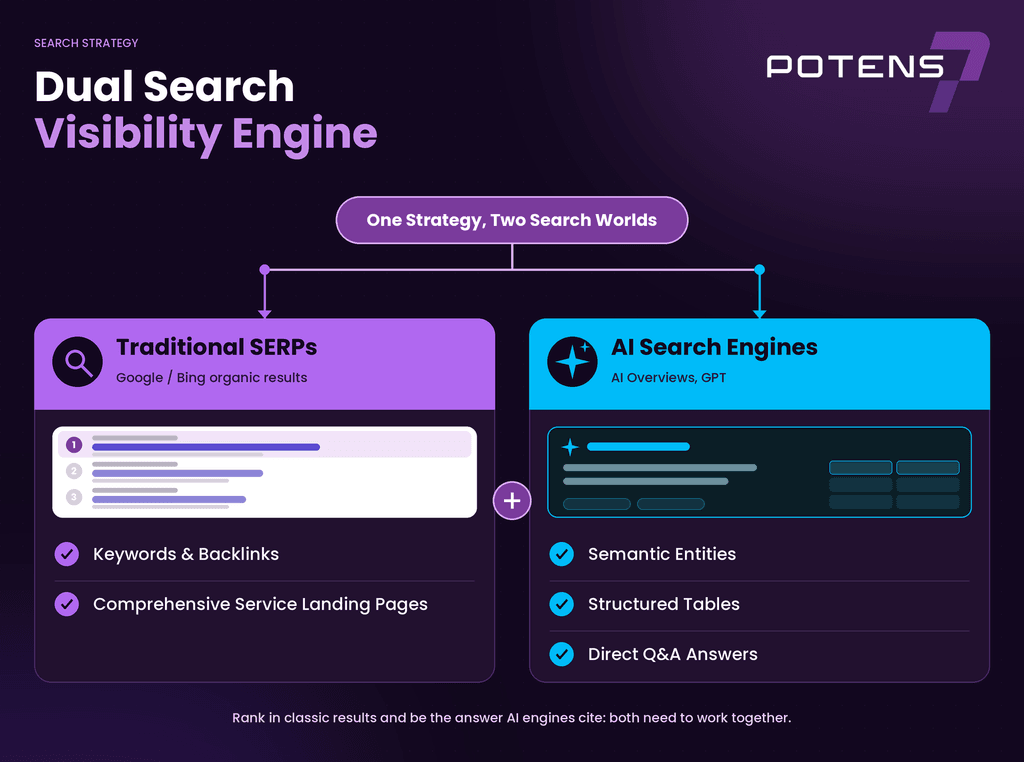
Creating High-Value Educational Content
Publish articles addressing specific conditions, symptoms, and self-care strategies:
- “Top 5 Exercises to Relieve Lower Back Pain at Home”
- “How Physical Therapy Speeds Post-ACL Surgery Recovery”
- “IMS vs. Dry Needling – What Is the Difference?”
Structuring Content for Generative AI (GEO) and Featured Snippets
- Provide Direct Answers First – Place a clear, concise 40-to-50-word answer directly beneath your H2 or H3 question headers before diving into deeper explanations.
- Utilize Structured Comparison Tables – AI models frequently extract structured data from comparison tables when answering direct patient queries.
- Use Clear Listicles and Step-by-Step Instructions – Format exercise tutorials or symptom checklists using numbered list syntax.
Clinics looking to upgrade their digital footprint often combine organic content efforts with professional social media services to distribute content across local community channels.
Link Building & Local Citation Strategies for Clinics
Backlinks, links from third-party websites back to your practice, remain one of Google’s fundamental ranking signals. They act as digital endorsements of your website’s trust and authority.
| Link Source Category | Example Target Platforms | Authority Level | Strategic Purpose & Value for Clinics |
| Top-Tier Health & Medical Directories | WebMD, Healthgrades, YellowPages Canada | High | Establishes baseline medical citation accuracy and foundational trust signals. |
| Local Sports Teams & Athletic Clubs | Community soccer leagues, running clubs, CrossFit gyms | High (Local) | Drives hyper-local relevance and captures direct referral traffic from active athletes. |
| Community Sponsorships & Events | Charity runs, local marathon sponsorships, youth sports | High (Local) | Earns high-trust local .org or local news backlinks while boosting brand goodwill. |
| Regional Health Publications | City wellness blogs, local magazine guest columns, news outlets | Moderate to High | Demonstrates practitioner E-E-A-T and positioning as a regional healthcare authority. |
| High-Authority Canadian Directories | N49, Yelp Canada, Cylex Canada, Provincial Health Registries | Moderate | Reinforces local NAP (Name, Address, Phone) consistency across Canadian search engines. |
High-Impact Link Building Tactics for Physiotherapists
- Sponsor Local Athletic Teams & Clubs – Partner with local running clubs, soccer leagues, or CrossFit gyms. Sponsorships typically yield authoritative local backlinks from their partner pages.
- Claim Top-Tier Canadian Citations – List your clinic on primary Canadian business directories including YellowPages.ca, Yelp Canada, N49, Cylex, and provincial healthcare registries.
- Collaborate with Local Health Professionals – Connect with orthopedic surgeons, general practitioners, podiatrists, and massage therapists in your community for cross-referrals and local digital mentions.
- Publish Original Local Health Insights – Share anonymized local athletic injury statistics or seasonal sports safety tips with regional news outlets to earn local media links.
Real Work Example – On-Page, Off-Page, and AI SEO Overhaul
To illustrate how targeted SEO for physiotherapy businesses operates in practice, here is a case study demonstrating an integrated digital optimization strategy.
| Metric / Category | Baseline (Pre-SEO) | Tactical Strategy Executed | Month 6 Results | Total Impact / Growth |
| Organic Traffic | 420 sessions/mo | Structured Q&A content for Google AI Overviews & expanded 8 dedicated service landing pages | 2,850+ sessions/mo | +578% Increase |
| Google Map Pack Rankings | Outside Top 10 | Built automated post-appointment review workflow & added 15 local sports/citation links | Top 3 for 14 Keywords | Local Map Pack Dominance |
| Online Appointments | 8 – 12 bookings/mo | Integrated Physician / Medical Clinic JSON-LD schema & conversion-focused booking CTAs | 52 Direct Bookings/mo | ~4.3x Conversion Growth |
Case Study Strategy Breakdown
- On-Page Architectural Overhaul – The clinic’s original website grouped shockwave therapy, vestibular rehab, and pelvic floor care onto one generic page. We built distinct, highly targeted service pages optimized for localized intent (e.g., “Pelvic Floor Physiotherapist in Mississauga”).
- AI SEO & Schema Implementation – Integrated custom JSON-LD schema across all practitioner bios and service pages. Structured core treatment headings with concise answer summaries, allowing the practice to earn featured snippets and inclusions in Google AI Overviews.
- Off-Page & Review Acceleration – Established an automated SMS integration that prompted patients for feedback following their final session in a plan of care. The clinic’s Google review count grew from 18 to over 110 authentic 5-star reviews within five months, securing top positions in the local Map Pack.
Executing a structured multi-channel growth plan often involves combining organic optimization with targeted PPC advertising to drive immediate patient inquiries while organic rankings mature.
SEO Analytics, Conversion Tracking, and Metrics
Deploying search strategies requires accurate conversion tracking to evaluate your patient acquisition costs and overall marketing return.
Essential KPI Tracking Tools
- Google Analytics 4 (GA4) – Track organic user volume, traffic sources, top-performing landing pages, and key engagement metrics. Configure custom conversion events for online booking button clicks and contact form submissions.
- Google Search Console (GSC) – Monitor impression volume, click-through rates (CTR), crawl errors, and exact query performance across search engine result pages.
- Call Tracking Software – Implement dynamic call tracking (using tools like CallRail) to attribute phone inquiries directly to specific organic traffic channels or local landing pages.
Physiotherapy SEO vs. Google Ads – Strategic Comparison
Clinic owners frequently debate whether to focus on organic optimization or paid search ads. The most successful clinics leverage both channels strategically depending on their growth goals and timeline.
| Strategy Dimension | Organic SEO Strategy | Google Ads (PPC) Strategy |
| Time to First Results | 3 to 6 months for sustained momentum | Immediate (starts generating traffic upon campaign launch) |
| Long-Term Cost Profile | Decreasing cost-per-lead over time; traffic persists | Ongoing cost-per-click; traffic stops when budget ends |
| Trust & Click-Through Rates | Higher organic CTR; patients trust non-ad listings | Lower overall CTR; some users skip sponsored links |
| Local Map Pack Presence | Essential for long-term organic Map Pack dominance | Can run Local Services Ads (LSA) at the very top |
| Ideal Primary Purpose | Building lasting brand dominance and lower acquisition costs | Filling immediate appointment gaps or launching new locations |
Combining a strong organic search engine presence with targeted pay-per-click campaigns allows practices to capture both top-of-funnel ad clicks and high-intent organic traffic.
Expected Timeline, Investment, and Costs
Building sustainable organic search rankings requires consistent effort across technical optimization, content publication, and authority building.
| Timeframe | Core SEO Focus & Activities | Expected Milestones & Business Outcomes |
| Month 1 | Technical site audits, NAP alignment, MedicalClinic schema deployment, and Google Business Profile optimization. | Technical crawl errors resolved, location data synchronized, and foundation laid for local tracking. |
| Months 2 – 3 | Launch of dedicated core service pages, creation of localized city landing pages, and setting up review collection workflows. | Early ranking movement – Initial keyword indexation and ranking gains across regional search terms. |
| Months 4 – 6 | Authority link building, high-intent healthcare directory expansion, and condition-based content marketing engine. | Noticeable business impact – Consistent Google Map Pack gains and a steady increase in direct patient bookings. |
| Months 6+ | Market dominance, search capture for Google AI Overviews, advanced conversion rate optimization (CRO), and competitor defence. | Compounding ROI – High-volume, predictable pipeline of organic appointment inquiries and low cost-per-patient acquisition. |
Typical Investment Costs
Professional retainers for a specialized physiotherapy digital marketing agency in Canada generally range between $1,500 and $3,500 CAD per month, depending on market competition, geographic scope, and service intensity.
When evaluated against the lifetime value of a patient ($800–$1,800+), securing just 3 to 5 additional organic patient bookings per month fully covers the campaign investment, making search engine optimization one of the highest-yielding growth channels for physical therapy practices.
Complete Physiotherapist SEO Checklist
Use this actionable checklist to audit your clinic’s digital presence and prioritize optimization tasks:
Google Business Profile & Local Map Pack
- Claim, verify, and complete your Google Business Profile.
- Select “Physical Therapy Clinic” as your primary category.
- Audit Name, Address, and Phone number (NAP) for 100% consistency across all web directories.
- Upload 15+ high-resolution photos of your clinic, staff, and equipment.
- Establish an automated system to consistently generate Google patient reviews.
On-Page & Technical Website Optimization
- Ensure the site loads under 2.5 seconds on mobile devices.
- Install an SSL certificate (HTTPS security).
- Create unique, dedicated service pages for every treatment modality offered.
- Build localized landing pages for each municipality or suburb served.
- Write compelling title tags and meta descriptions for all core pages.
- Implement JSON-LD MedicalClinic and MedicalCondition schema markup.
Healthcare E-E-A-T & Authority Building
- Publish detailed clinician bio pages complete with licensing credentials and college registrations.
- Add clear medical review disclaimers to educational blog articles.
- Cite reputable peer-reviewed journals (BJSM, JOSPT, PubMed) across health content.
- Acquire local backlinks via sports club sponsorships, community partners, and regional citations.
Conversion Tracking & Analytics Setup
- Configure GA4 conversion tracking for Jane App / online booking triggers.
- Set up phone call tracking to measure direct mobile inquiries.
- Connect site to Google Search Console to monitor impressions and keyword trends.
Reviewing a complete SEO checklist helps clinical directors identify performance gaps and keep digital marketing priorities organized.
Suggested Further Reading
To further expand your digital marketing knowledge and build a comprehensive clinic growth engine, explore these specialized industry guides:
- SEO For Chiropractors – How Chiropractors Can Attract More Patients Through Google
- Plastic Surgeon SEO – Strategies To Generate More Patient Leads
- SEO For Dentists – How Dental Clinics Can Get More Patients Online
Frequently Asked Questions About Physiotherapist SEO
How long does SEO take to produce results for a physiotherapy clinic?
Most practices observe initial indexing improvements within 30 to 45 days. Significant local Map Pack visibility and a noticeable increase in patient appointments typically take 3 to 6 months of consistent technical optimization, local citation building, and content publishing.
What is the difference between general local SEO and physiotherapist SEO?
Physiotherapy SEO operates under Google’s strict YMYL (Your Money or Your Life) standards. It requires compliance with healthcare communication rules, specialized medical schema markup, clinical E-E-A-T verification, and targeting condition-specific queries that general local SEO strategies do not address.
Can I do SEO for my physiotherapy clinic myself?
While clinic owners can handle basic tasks like claiming a Google Business Profile and asking patients for reviews, scaling high-competition search engine rankings requires specialized expertise in technical site health, structured schema code, E-E-A-T content strategy, and authoritative link acquisition.
How do I optimize my clinic website for Google AI Overviews and AI search engines?
Structure content using direct Q&A formats, incorporate clear data comparison tables, implement rich JSON-LD schema, and ensure all health claims are backed by licensed practitioner sign-offs and reputable medical journal citations.
Is social media marketing a substitute for search engine optimization?
No. Social media builds community engagement and brand awareness, but search engine optimization captures prospective patients at the exact moment they experience acute pain and actively search for immediate care. The two channels complement each other as part of a complete digital growth plan.
Partner with Potens Digital to Grow Your Practice
Scaling a physiotherapy practice requires a steady flow of new patients. Relying solely on offline referrals or unpredictable word-of-mouth leaves your clinic vulnerable to changing market dynamics and local competition.
At Potens Digital, we specialize in crafting custom search engine strategies that turn Google into your practice’s most reliable revenue driver. From complete technical overhauls and medical E-E-A-T content publishing to local Map Pack dominance and conversion rate optimization, our team delivers transparent, measurable results for Canadian healthcare practices.
Your Digital Growth Partner
Ready To Fill Your Clinic’s Appointment Schedule?
Contact Potens Digital today to request your customized physiotherapy search audit and strategy blueprint.

